Showing posts with label First World War. Show all posts

Sunday, March 15, 2026

Interfaith Iftar at Minhaj Ul Quran Mosque: A Special Evening in Forest Gate

Last Friday week I had the real pleasure of attending an Interfaith Iftar at the Minhaj Ul Quran Mosque on Romford Road, Forest Gate, kindly invited by my colleague Cllr Alam.

It’s a mosque I’ve visited before — most memorably for the remarkable exhibition Far From the Western Front: South Asian Stories of the First World War. That exhibition explored the experiences of South Asian troops who served with extraordinary courage and sacrifice. It is no exaggeration to say that without their contribution, the outcome of the First World War — and arguably the Second — could have been very different. https://www.johnslabourblog.org/2017/04/far-from-western-front-south-asian.html

Friday’s Iftar carried that same sense of shared history, solidarity, and community into the present moment.

Newham Labour’s Mayoral Candidate, Forhad Hussain, was also invited and spoke at the event, alongside Stephen Timms MP, Cllr Alam, and his Forest Gate South Candidate Robert Carter‑Lennox — who had fasted that day for the very first time. Each offered thoughtful reflections on Ramadan as a time of discipline, compassion, and generosity.

What stayed with me most, though, was the atmosphere in the room. Myself and colleagues — some Muslim, some not — sat among worshippers as they broke their fast. People who had been fasting since dawn shared their food and drinks with us. That simple act of hospitality, offered after a long day of abstention, carried a profound sense of warmth and welcome.

It was, in every sense, a very special occasion — a reminder of the strength of Newham’s interfaith bonds, and of how much we gain when we sit together, learn from one another, and share moments of reflection and celebration.

Sunday, July 28, 2024

110th Anniversary of the start of World War 1


This morning I walked with Gill from Stratford to Sutton House in Hackney. Sutton House is a Tudor manor built in 1535, owned by the National Trust and is the oldest residential building in East London.

It is well worth a visit and I will post upon it another time. I noticed outside the building that there is a plaque remembering that Sutton House was bought by the National Trust in the 1930s with the proceeds of a bequest made by William Alexander Robertson in memory of his two brothers killed in World War I.

Today is the 110th anniversary of the start of World War 1. Above is one of my favourite pictures of my Welsh maternal Grandfather (Taid), Frederick John Matthews MC, who served in that war from 1915-1918. He is seated next to one of his brothers (whose name I am trying to confirm). It is incredible that he survived front line trench warfare in Gallipoli, Belgium and France. Our family was very lucky but so many others like the Robertson's were not. 

Sunday, February 27, 2022

Thaxted Circular Walk (and return to the Church of the "Red Vicar")


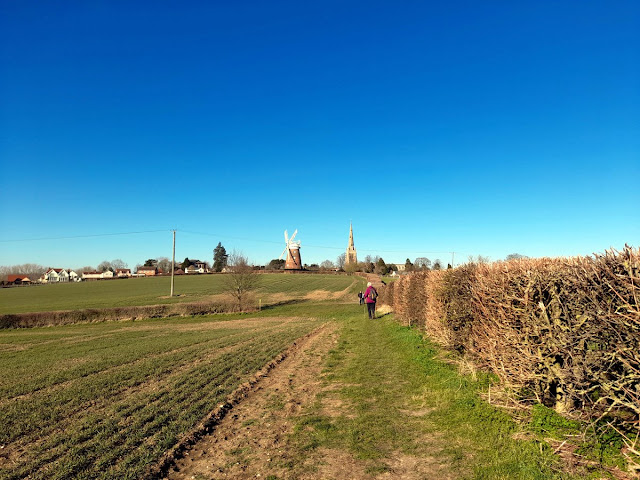
Gill and I returned today to Thaxted in Essex to follow this 6.5 mile  circular walk from our old version of the local Pathfinder Guide. We did this walk previously in 2014. 

Today was a lovely tramp through largely quiet countryside but had no great challenges.  There was however noise from planes passing over to land at Stanstead airport. 

The weather was lovely, with blue skies and sunshine but a cold wind. We hardly saw anyone during the walk. There were a number of my favourite ancient enclosed green lanes. Some paths were a little muddy but if it had been wet, you would need to wear wellies or gaiters. 

We saw wild deer, red kites birds of prey, squirrels, numerous other birds, lots of snow drops, daffodils and beautiful early tree blossom. Spring is definitely on its way. 

In 2014 I posted here on this walk that a past priest of the amazing Thaxted church, was known as the "Red Vicar", who use to fly the Red Flag banner of the Soviet Union and Shin Fenn, inside the church and then had to be protected by dismissed Police strikers from outraged locals. 

On the way back we stopped off at the 15th century timber framed Guild Hall and noticed a remembrance plaque to local men, who had died in the first and second world wars. Apart from noting that 55 killed during the first world war, compared with "only"10 in the second. You can see that liberty and freedom can some times come at a terrible price. 

Gill noticed that the names of a "John Gray" and a "Walter Gray" were recorded on the plaque as being killed in action during the first world war. It would appear from my internet searches that both of them were local young men who were killed in 1917 and may have been related but were not siblings. 

After a pleasant drink in the local "Swan Pub" we drove back to London, listening to the dreadful news updates on the vile and fascistic invasion of brave Ukraine by Russia and its foul dictator, Putin.  

Check out more photos https://www.facebook.com/permalink.php?story_fbid=10158647568778434&id=732243433

Wednesday, July 01, 2020

"East Ham War Pensions Committee: Your Fight Is Our Fight"

Historic photo of  dependants of World War One ex-service men protesting against cuts to War pensions in 1919. The authorities claimed that the local East Ham War Pensions committee did not follow the "rules" and gave out too generous benefits.

Check out "British Widows of the First World War - The Forgotten Legion" about this story and the dreadful treatment of many widows whose husbands had been killed for post war "immoral misconduct".

Hat tip @LondonNurse2015

Tuesday, June 23, 2020

Private Thomas Highgate - the First to be Shot at Dawn (2020 update)

Early in 2014 I posted here on a controversy in the village on Shoreham in Kent on whether to add the name of Private Thomas Highgate to its War Memorial.  19 year old Thomas was the first soldier to be shot for desertion by the British army authorities in the first world war.

Some local residents also posted strongly felt comments on why (or why not) he should be remembered in this way.

At the time it appeared that there was a space on the memorial for his name and now Thomas had been pardoned by the British Government (2006) that eventually his name would placed there.

Recent discord about historical statues and memorials reminded me of Thomas.

This weekend I went back to Shoreham to take another walk around its beautiful countryside and to check what had happened.  I saw that his name had not been entered and instead the space had been filled with another fallen son of the village, who had been missed off the original plaque.

Personally, for what it is worth,  I think that Thomas should be remembered on this memorial in some way, but the decision is not mine.  I hope that eventually there would be a local consensus on what to do to remember Thomas and also the other 305 British & Commonwealth soldiers who suffered the same fate during the first world war. 

Saturday, April 25, 2020

The "Spanish" flu epidemic & a Canadian Bolshevik Revolt in Wales

For the reasons given in my post from 2008 (see below) I have been conscious of the impact of viral pandemics from an early age.

There are some 80 graves of Canadian soldiers at the Marble Church in Bodelwyddan, North Wales.

Up to 76 of them may have died from the 1918/19 flu epidemic and at least 4 were killed after a violent confrontation between military authorities and those wanting to go home to Canada asap after the end of the first world war (including some who wanted to set up a Bolshevik revolutionary Soviet in the nearby military camp).

Check out Spanish flu - Wikipedia and I think that most people will recognise some striking similarities (as well as differences) with our present crisis.

https://www.johnslabourblog.org/2008/05/come-on-bolsheviks-first-british-soviet.html

Tuesday, August 13, 2019

St Matthews public meeting on Crime and ASB

A lovely picture from last Friday evening when Councillors and officers met Residents and Police to discuss how to tackle jointly crime and anti-social behaviour in the area (Forest Gate South ward adjacent to Romford Road).

The meeting was Chaired by Cllr Shaban Mohammed and went in my view really well with constructive but frank views expressed and received. Residents seemed to have been pleased with recent changes (thanks to the new ward Council Housing liaison officers who have been very proactive). Residents let us know that they expected us to deliver for them.

The Police and the Council undertook to support residents with improved enforcement action and also for housing to make improvements in order to try and "design out crime".

We also had a decent discussion about the impact that Government cuts to Police numbers and local authority grants has had. 

I have never been inside St Matthews Church before and did not realise how large it is and its beautiful stained glass windows. It parish war memorial from the first world war was also striking and it stuns you how many local men were killed in a relatively small London parish. There were also 3 family plaques on the walls remembering the war time deaths of young parishioners.


Tuesday, November 13, 2018

West Ham All Saints Remembrance Service Sunday 11 November 2018

On Sunday I represented the Mayor and Newham Council at the 1918-2018 Remembrance Ceremony at West Ham Parish Church All Saints with Chair of Council Cllr Joy Laguda and our Director of Finance, Michael O'Donnell. With our local MP Lyn Brown, we each laid a wreath of poppies together with G Company 7 Rifles (our local British Army Reservist unit based nearby in West Ham), Police, British Legion and local residents.

It was good to see a large contingent of soldiers in uniform from our local regiment 7 Rifles present. In past Remembrance ceremonies at this Church, members of G Company had been on active service in Iraq and Afghanistan.  I am now of an age, that they all look too young to put their lives at risk and wish that fighting for all countries and all beliefs was only restricted to older folk such as myself over the age 50.  I doubt that many wars would still happen if this was so.

Chair of Newham Councillor Scrutiny Committees, Cllr John Whitworth and Councillor Winston Vaughan also attended (Cllr Vaughan is a British Army Veteran) While local Cllr, Jane Lofthouse actually had a lovely singing voice (and saved the reputation of the Council since none of us could hold a note).

Newham Council had supported 8 separate Remembrance events across the borough this historic weekend with the Mayor, Cabinet, Senior officers and Councillors attending.

The new Parish Priest, Revd Cannon Alex Summers, led an excellent and moving service (despite a heavy cold) and spoke about two of his great uncles, who were killed in the first world war. He and his young family had visited the war cemetery of one of his uncles in France and noted that the graves of British and German dead were buried alongside each other. It seemed fitting that former enemies were laid in peace together. I completely agree.

The Church is a beautiful Grade 1 listed building and was founded in the 12th Century.  I recommend a visit. There is a Beethoven Concert there on 24 November 2018 which I sadly cannot attend due to pre booked clash.

After the ceremony my wife Gill and I went over to the Queen Elizabeth Olympic Park to view the "Shrouds from the Somme". Visit, look and listen to the endless names of the unidentified dead. It is heartbreaking.

Saturday, September 01, 2018

Walter Tull & 11 November 2018

A couple of weeks ago I went to Folkestone (via the high speed rail link in 46 minutes) for a Friday night beer and curry with an old mate. The following morning hangover cure was a brisk walk along the beach and back along the prom.

Near the town War Memorial on the prom there was an information board which featured a Newham connection (above). Walter Tull was born in Folkestone 1888 but he was also one of the first UK black professional footballers and was first spotted playing for Forest Gate based (Now London Borough Newham) Clapton FC.

After the outbreak of the First World War he joined the British Army in 1914 and was commissioned as an officer in 1917. Arguably the first ever Black commissioned officer despite apparently military regulations forbidding it. He was killed in action in Northern France 8 March 1918. His body was never recovered.

My Taid (Welsh for Grandfather) Captain Frederick Matthews MC RND, another working class volunteer, also fought in the Western Front during First World War. He survived.

The Folkestone War memorial is next to what is now called the "Road of Remembrance". During the First World War troops used to get off trains at a nearby depot then march down that road to the port below then take the military ferry to France. I suspect that Walter and my Taid had marched at different times up and down that same road several times during the War.

On 11 November 2018 it is the 100th anniversary of the end of the First World War. Time to remember and reflect on everyone (regardless of class, race and nationality) who fought in this bloody, dreadful War. 

Monday, March 26, 2018

Clavering Walk

Off message,on Sunday I had my first day off from politics and the union for a long time. I downloaded this 8.5 mile circular route from the free website Essexwalks.com and Gill and I drove to Clavering near Bishop Stortford about 45 minutes from East London.

The weather started off dry, cold and overcast but brightened up in the afternoon.

The walk went through the chocolate box Essex villages of Clavering, Arkesden, Wicken Bonhunt and Rickling.  By the end of the walk you become somewhat bored by over exposure to beautiful thatched cottages, babbling streams, Essex big skies and ancient deserted churches. It was quite undulating terrain for Essex but nothing too hilly. .

We stopped for lunch outside St Margaret's Church in Wicken Bonhunt. Inside the Church there was a plaque recording villagers killed in the First World War.  24 men from such a small community compared to 5 in the Second World War. Many had the same surname. 4 had the surname "Banks", 2  "Johnson", 2 "Kettridge", 2 "King", 2 "Perry" and finally 2 had surname "Stanley" (there was even one "Arthur Gray"). Some families must have lost all their sons.

For some much older history check out "The Domesday Book refers to the separate manors of Wica and Banhunta. It records that Saxi, a free man, held Wicken before 1066 as a manor for 3 hides and 13 acres with 9 villagers, 8 smallholders and 3 slaves with 2 ploughs in lordship plus 3 men’s ploughs. Woodland supported 100 pigs, 1 cob, 40 sheep and 36 goats. Its value is given as ‘always £7’".

Who knew the Saxons had slaves in England.

We hardly saw any other walkers. Apart from the big fat cat we did see wild deer, Mad March hare and bumblebees.While there was also a cacophony of nest building birdsong. Some unwelcome rumbling noise from the M11 and Stansted airport planes but overall it was a lovely and relaxing walk. Strongly recommended.

Saturday, April 08, 2017

Far From the Western Front: South Asian Stories of the First World War

After a Labour Party canvass session in Forest Gate last month, Councillor Anam Islam took Councillor John Whitworth and I to this exhibition in the Minhaj-Ul-Quran Cultural centre in Romford Road.

This was a fascinating examination of the untold contribution made by South Asian troops to the British victory in the first world war and the hardship and ill treatment that many of them received while doing their bit for King and Empire.

The sacrifice and bravery of so many South Asian troops in the deadly trench battles in France and Belgium is beginning to be recognised but many also served and suffered in difficult, unhealthy and at times, murderous campaigns in Gallipoli, the Middle East and Africa.

This is a story not only about those who "volunteered" to be soldiers (instead of sometimes facing starvation and poverty if they remained at home) but about the impact of separation on their wives and children.

The brutality of war and colonial rule is made clear. I for one was not aware that 47 Muslim Indian troops were publically executed by British firing squads at Singapore in 1915 following a bloody anti-colonial mutiny.

But there is no doubt I think that the contribution of South Asian troops to victory in 1918 (and also 1945) is immeasurable. We owe all of them our thanks and respect.

This story is also somewhat personal to me. My maternal Grandfather, fought alongside South Asian troops in Gallipoli and later in the European trenches. . Whatever the rights and many wrongs of the First World War, I think we have to understand and honour all of those who took part. I thank the organisers of this exhibition for educating me and reminding us of a previously untold history. 

Friday, November 06, 2015

The first Indian army VC

In the run up to Remembrance Sunday this is a good time to remember the heroism of Indian Army soldiers, such as Khudadad Khan who was awared the first Indian Victoria Cross in the First World War.

In 1914 Khudadad and his out numbered comrades held off a German attack until all the others were killed and he was wounded and left for dead.

Thanks to their bravery, reinforcements were able to arrive in time and hold off the Germans.

"Despite the severity of his injuries, the hero lived to a ripe old age, dying in Mandi Bahauddin, Pakistan, in 1971"

At the outbreak of war, the Indian army was 1.3 million strong, with the ranks including 100,000 Sikhs and 800,000 Hindu troops.

Of that massive force, 62,060 were killed in action".

8 Indian nationals earned the Victoria Cross during the First World War. See here for details of Remembrance events in Newham this Sunday and Armistice Day.

Lest we forget.

Sunday, July 19, 2015

100th anniversary of my Grandfather arriving at Gallipoli

According to this history of the "Hawke Battalion" Royal Naval Divison (RDN) by Douglas Jerrold, my Grandfather ( Taid in Welsh) Sub-lieutenant, Frederick Matthews, first joined them on active service a 100 years ago yesterday on 18 July 1915.

The Battalion was "dug in" occupying trenches at the Gallipoli beach head only a short distance from Turkish Army positions.

It was the height of summer and apart from insanitary conditions and disease there was constant shelling, sniping, attacks and counter attacks. The Battalion stayed until the allied retreat in January 1916.

My "Taid" was an apprentice in a South Wales Steel works before he joined the RND. He served in the Battalion throughout the war and also fought in France and Belgium. He later became a Captain and was awarded the Military Cross in 1917.

I will try and post in chronological order upon the major events that he and the Battalion experienced in the course of the War. While Gallipoli must have been a terrible experience, some of the battles that the Hawke Battalion took part in later on were far worse and completely horrifying. 

The family picture above is of my Taid (sitting on the left with arms folded)  in the trenches with an unknown comrade which the family believe is probably Gallipoli in 1915.

Tuesday, April 28, 2015

Midshipman George L. Drewry VC RNR

Yesterday morning I attended a Commemorative Stone Ceremony at the Cenotaph in Central Park, East Ham, Newham, London.

It was to mark the unveiling of the first of 5 paving stones to be placed at the Cenotaph to remember the heroism of five Newham residents, who won our nations highest military honour, the Victoria Cross, during World War One.

Forest Gate born, George Drewry, won his Victoria Cross age 20 during the Gallipoli landings on 25 April 1915.

The ceremony was very much a naval affair led by Hon Vice Admiral The Lord Sterling of Plaistow, GVCO CBE RNR. There were other Royal Navy personal, Sea Cadets and a Royal Marine Bugler who played "The Last Post".

The Rifles, the British Legion, Police, Council, faith groups, local School children and residents were also there to honour Midshipman George Drewry.

In a nice touch they had a modern day Royal Navy Midshipman (this is the most junior Officer rank) give the account of the incredible heroism by George Drewry, who despite bring wounded, repeatedly risked his life under heavy enemy fire to enable troops from his ship to land at Gallipoli.

Check out the tale at Newham Story.

I hope to attend all the ceremonies commemorating Newham residents who won the Victoria Cross during First World War. 

The ceremony yesterday was special to me since (as already mentioned in this post) my Grandfather, Frederick Matthews MC, was also in the Royal Naval Reserve (RNR) and fought in Gallipoli.

Saturday, April 25, 2015

The band played waltzing matilda


Today is the 100th anniversary of the beginning of the First World War Gallipoli campaign.  The 8 month conflict was one of the most vicious of that war.

This song was written by Eric Bogle in 1971 and was today described by a good friend of mine (and who has a doctorate in History) as "the most powerful anti-war song I have ever heard".

Gallipoli is very important to Australians  and New Zealanders but British and French troops also served there. My maternal Grandfather, Frederick Matthews, fought there with the Hawke Battalion, Royal Naval Division. He arrived after the landing in July 1915. I will post further in July about him and his Battalion's experiences in Gallipoli and then later in France. 

Wednesday, November 12, 2014

96th Anniversary of the Armistice - The Cenotaph, Central Park, Newham

Yesterday morning at 11am there was another beautiful Remembrance Service in Newham.

On Sunday I went to All Saints Church in my Council ward West Ham.

On Armistice Day itself I went to show my respect with many others at the Cenotaph in Central Park, East Ham.

It was very well attended and crowds of mostly school children completely encircled the Cenotaph.

East Ham MP Stephen Timms and the Mayor laid wreaths as did many local organisations and schools. Local children gave some fantastic readings and moving poetry recitals.

St. Antony's School recounting of "In Flanders Field"  by John McCrae, was particularly poignant and I am sure that I was not the only one with something in my eye by the end.

In Flanders fields the poppies blow
Between the crosses, row on row,
That mark our place; and in the sky
The larks, still bravely singing, fly
Scarce heard amid the guns below.

We are the Dead. Short days ago
We lived, felt dawn, saw sunset glow,
Loved and were loved, and now we lie
In Flanders fields.

Take up our quarrel with the foe:
To you from failing hands we throw
The torch; be yours to hold it high.
If ye break faith with us who die
We shall not sleep, though poppies grow
In Flanders fields.

Monday, August 04, 2014

4 August 2014 - 100th anniversary of the start of World War One

This morning at 11am I went to the Cenotaph at East Ham Central Park for a Newham Council ceremony to mark the 100th anniversary of the beginning of World War One.

A British Legion representative laid the first wreath followed by the Mayor and representatives of the former boroughs of East and West Ham.

One lovely spontaneous touch was as the wreaths were being laid, a passerby stopped and started singing a beautiful lament to the fallen "Sleep on Beloved, Sleep on and take your rest".

My Grandfather, Frederick John Matthews MC, Royal Naval Division, fought in the First World War. On 5 August 1914 he was still an apprentice "mechanical engineer and draughtsman" in a South Wales Steel works. He left to join up on 2 September 1914 and returned to work (briefly) in January 1919.

I hope in the coming years to follow in his footsteps a hundred year later, starting off next  year at Gallipoli in Turkey then the trench battles of France and Belgium.

hat tip picture Cllr Ayesha Chowdhury,

Monday, April 14, 2014

Appeal to Welsh Rugby Footballers (1914)

Not sure whether to smile or cry at this Welsh newspaper clipping from the First World War.

I doubt that any form of footballer skills were much use against German barbed wire, machine guns and artillery during British infanty attacks on the western front.

You can see the pressure that was put on young men to join up- if you didn't you were either unpatriotic or a coward (or both)

See list of Welsh International Rugby Union players killed in First World War.  

Hat tip Captain Swing (who I have asked for a reference for this clipping)

Sunday, January 12, 2014

Private Thomas Highgate - the First to be Shot at Dawn

I think people know that on the 28 July this year it will be the 100th anniversary of the start of the First World War. Not many will know that within a few weeks the first British soldier had been shot by firing squad for desertion.

This morning I was looking for a Sunday walk in the country and picked this 7 mile circular route starting in Shoreham, Kent.

Before I left I checked google for Shoreham and on Wikipedia found this "Shoreham was the birthplace and home of Private Thomas Highgate, who was the first British soldier to be shot for desertion during the First World War on 8 September 1914, following the Battle of and Retreat from Mons. In 2000, Shoreham Parish Council voted not to include his name on its war memorial. However, after a posthumous pardon in 2006, it was considered that his name might be added.[1]"#

I wondered if 19 year old Thomas's (see picture above) name had indeed been added to the War memorial and decided at the end of the walk to have a look.

The walk itself was wonderful (click for photos) and I would recommend it. Lots of up and down hills with great views and different scenery. You go past the historic Roman villa and Castle at Lullingstone. The only significant downside being some noise from nearby (but very largely unseen) motorway.

At the War Memorial near the old village bridge there was no sign of his name on it. I have since found out via the Internet that the issue has been hugely controversial in the village. It appears that 2 (or 3) of his brothers were later killed in the War but also that Thomas had deserted once before while in the (peace time) Army and had been imprisoned for 42 days.  It is reported also that Thomas had no witnesses for his defence at his trial for desertion since the rest of his unit were killed in the Battle.

I think that this is at the end of the day a matter for the local community and no-one else.

I will say that on the way out of the village I noticed 3 local teenage boys sitting on a wall near the village shop, probably aged about 15, looking bored and fed up as only adolescent boys can be. They were only a couple of years younger at most than Thomas was when he joined the Army at 17. I do wonder how they would have dealt with the aftermath following the carnage at the Battle of Mons?

UPDATE: BBC report 31 May 2014


Sunday, October 27, 2013

Forgotten Heroes - Remembering the Muslim sacrifice in the battle against tyranny

On Thursday I casually retweeted an interesting looking tweet from Rokeby School about "Remembering the sacrifice of Muslim soldiers, who gave their lives and their limbs in the name of duty"

Today I had a closer look at the tweet and its link to this article and video.

I would recommend that all EDL and UKIP supporters should read about the sacrifice of Muslim soldiers in the first and second world war, who fought and gave their lives to save Britain from tyranny and for their King.

Some highlights:-

"Visit the Menin Gate at Ypres in Belgium and you will see these and numerous other obviously Muslim names on the memorial that is dedicated to the commemoration of soldiers killed in the Ypres Salient of the First World War, whose resting places are unknown. It is a large Hall of Memory, honouring 54,896 British and Commonwealth soldiers who could not be buried, their names cut into vast panels.

"The marble in Ypres that bear these names will endure, but they remain cold and silent. As a country – and as Muslims in particular – we have failed to honour the memory of those who fought to protect the freedoms we enjoy today. The memorial in Ypres testifies to the service of Muslim soldiers but we, their descendants and their debtors, have neglected to remember the scope of their sacrifice"

"Military historian Major Gordon Corrigan says the role of the British Indian Army was vital to the war effort; had they not helped fortify the front line during the First World War the Germans might well have broken through and made it to the ports on the English Channel. “The Punjabi Musselman was regarded as the backbone of the old Indian army, and constituted about a third of the British Indian Army. Known for their reliability, they were steady men who could be depended on to carry out any task at hand.”

"From the trenches "In May 1915 Subadar Muhammad Agia of the 57th Rifles wrote, “It is just like the grinding of corn in a mill; there is no counting the number of lives lost. Not a single British or native officer of the old regiment is left, and not one sepoy.”

"British officers who led Indian regiments immersed themselves in the culture of India; learning to speak the same language, even eating the same food as the men they were leading. Major Corrigan explains, “The reason the British were better at running armies not of their race was because of the accommodations they made; unlike the French who would make recruits learn their language, the British Officer was expected to learn the language of his men. Urdu was the official language of the Indian Army at the time but they also had to learn regional dialects and have specialist knowledge of the religious needs of their men.”

"Stationed in France at the time of Eid in July 1917, Abdul Ali Khan wrote, “All of the Muslims of the Division had their prayers together and the assembly was close to our regiment. We, as far as possible, gave them food and tea. About 1,500 men assembled and prayers were offered for the victory of our King.”

"so important was the Muslim contribution in both World Wars that Churchill himself wrote, “We must not on any account break with the Muslims who represent 100 million people and the main army elements which we must rely on for the immediate fighting.”

"Field Marshall Sir Claude Auchinleck, a British army commander during World War II, “Britain couldn’t have come through both wars if they hadn’t the Indian army.”

"there was also the Palestine Regiment; and in World War II Arabs and Jews fought together under the British flag against Nazi Germany and Fascist Italy".

"World Wars I and II connect every family in Britain. “If more was known about the contribution of so many Muslim soldiers of the British Indian Army, it might help to restore a sense of pride, and cement the social bonds of different communities in British society,” Jahan suggests. “This would turn the idea of a shared heritage into a meaningful weapon against prejudice.”

"The recognition of a shared past has the potential to give us a sense of a shared future; a future not marred by war, but rather one of contributing to the common good. That is why this Remembrance Day we must honour all those who died, including the Muslims who gave their lives for the freedom of this country".

...and so say I. Last Remembrance Day I went to Menin Gate at Ypres in Belgium and you could clearly see the names on the monument of the many Muslim, Sikh and Hindu soldiers who died in Flanders fields.