Showing posts with label Clive Betts MP. Show all posts

Wednesday, September 18, 2024

Labour Party Conference Fringe 2024 ‘A new deal for working people – how will investors react?’


 Labour Party Conference Fringe 2024

‘A new deal for working people – how will investors react?’

Sunday 22 September, 12.30 – 13.30, Room 6, Liverpool Arena

SPEAKERS

· Liam Byrne MP, Chair, Business and Trade Select Committee and Chair, Global Parliamentary Network on the World Bank and IMF

· Janet Williamson, Senior Policy Officer Corporate Governance Policy and Collective Bargaining, TUC

· Cllr John Gray, Vice Chair, Local Authority Pension Fund Forum (LAPFF)

· Chair: Clive Betts MP, Chair Local Authority Pension Funds Westminster Forum

I am looking forward to the Labour Party conference and intend to visit as many Social housing and pension fringes as possible. On Sunday I am taking part in a panel debate on behalf of the Local Authority Pension Fund Forum.

Wednesday, November 15, 2023

Confiscate the Homes of Bad Landlords

Hat tip to Housing Journo @PeteApps on this Observer article and well done to Clive for coming out with something quite radical but really sensible and worth doing.

My only hesitation was "Great idea but I do think to be fair & consistent that social landlords should be subject to the same penalty (and confiscated homes placed elsewhere also)"

Why should rubbish social landlords be treated differently than rubbish private landlords? For example, in my 11th year as a national UNISON NEC member for Housing Associations, I can tell you that a minority of them can act as badly as any rogue private landlord.

Tuesday, October 17, 2023

‘How can we put an end to greenwashing? LAPFF & Smith Institute Fringe at Labour Conference 2023


This is my presentation to this fringe. Hat tip Paul Hunter from PRIC for excellent speech notes.

"Thank you Clive. I am delighted to be here in Liverpool and looking forward to today’s discussion.

I am John Gray, I’m councillor in Newham, I’m chair of Newham Pensions Committee and I am here as vice-chair of the Local Authority Pension Fund Forum (known as LAPFF) which represents the interests of 87 public sector pension funds and 7 pool companies. I also wear various trade union pension hats. 

If any of you have worked or work in local government, the chances are you will have a pension with one of our member funds. If we have any councillors in the room, you or colleagues may well sit on the pension committee.  

As you can imagine as a major UK employer, our local authority pension funds have a lot of members which means collectively we hold a significant amount of assets – around £350 billion - much of which is invested in large international companies.  Around 6 million Brits have Council pensions

The role of LAPFF is to engage with investee companies on the way they treat our planet, how they behave towards people, and more generally the way that they are run and managed.

These issues matter in and of themselves, but as trustees of pension funds they also matter because they carry significant investment risks and opportunities. Indeed, for anyone with a pension these issues should also matter to you because failure to consider them puts at risk your retirement income.

In this context and that of our topic for discussion, I thought I would use my time today to focus on three main areas (in fringe speeches everything comes in threes'):

· Why greenwashing is an issue for investors.

· What investors can do to tackle it?

· And from an investor perspective the role government could play.

So why does greenwashing matter to investors?

The risks of climate change to our planet, society and economy should go without saying. However, in truth they cannot be repeated enough. From an investor point of view, climate change poses systemic risks to the whole economy, impacting every single investment. There are also specific risks for companies we are invested in, that will undoubtedly be left behind by the energy transition if they don’t decarbonise their business model quickly enough.

But where does greenwashing fit in here. Well to start, if information provided by a company is unclear or misleading then assessments of risks may be inaccurate which will affect investment decisions and could leave us as investors exposed.

It also means that stewardship activity we undertake could be impacted, including which companies to engage, in the asks we make of company chairs in meetings we have with them and in the voting positions we take at Annual General Meetings.

To give you an example of what we experience. We too often see companies describe themselves as having science-based climate targets. What’s not to like about that, who can argue with science.

However, when you look under the bonnet of the statements, we see a more complicated picture.

This can include a climate target which only covers so-called Scope 1 and 2 emissions – emissions from a company’s own activity – and not scope 3 emissions - pollution from their product which is used by its customers. And in the case of an oil and gas company or a carmaker that is precisely where most emissions are and where real climate risks lie.

In such instances where information is unclear, the climate risks facing a company could be masked while at a macro level it could breed complacency about the pace of climate action.

But what can investors do?

To start, investors should look beyond the glossy green images within sustainability reports and not take the information that is provided by companies at face value.

A good example of this is on the issue of planting trees to offset emissions. Leaving aside the cost or the displacement of people, when we as LAPFF added up the tree planting proposals of major emitters you know what we concluded? That we were going to need a much bigger planet to plant all those trees.

Investors also have a role more generally in scrutinising plans and the expectations we make of companies. Setting out a long-term target is not enough when action is needed now. So short term targets which can be measured and not avoided through greenwash is an essential ask of investee companies.

But we don’t just have a role in assessing information and asking for more, we also have a role in challenging companies. And on the issue of offsetting emissions our engagement with companies is bearing fruit with growing recognition of the limits offsetting will deliver.

And where plans are not credible or misleading, collectively investors should be doing more to voice their concerns and escalate action by voting against company directors at AGMs.

But we can’t do this alone. Which brings me on to the last point, the role of government.

Greenwashing is clearly an issue that regulators and governments are looking at, both regarding company disclosures but also green taxonomies, investment products and sustainability labels.

This is good first step but there are further interventions which could help further.

The first area is mandatory company disclosures. If we are going to distinguish between a company that is taking action and one that’s just talking a good game, then we need hard and comparable numbers within company reports covering areas such as investment in the transition.

Second, when the Transition Plan Taskforce reports government should push ahead with setting out expectations for how companies should undertake, integrate, and report their climate plans. This will make information comparable and clearer which will help guard against greenwashing.

And it is critical that these expectations of companies include how they are considering the social dimensions of the transition. A shift to net zero will only happen if we have a just transition for workers, communities and consumers.

Third, government can look at the corporate governance code, including around whether to make sustainability committees compulsory and requiring companies to produce a skills matrix so we can see the actual competency of boards on issues such as climate change.

And lastly, as investors we feel we should be able to have a direct say on company climate plans. LAPFF has been writing to companies calling for a vote on transition plans which will help scrutinise plans to both guard against greenwashing and ensure credible strategies are in place. But we think these votes at large listed companies should be put on a mandatory basis. In France, a proposed law is in the process of being passed which will do just that and could easily be adopted in the UK.

So, to conclude:

· Greenwashing matters because it threatens the pace of the transition and for us as investors it creates risks – and time is very much of the essence.

· From an investor perspective, we have a role in scrutinising information and challenging greenwashing – after all we own these companies.

· And lastly, to empower investors to do more, government can help by mandating improved transparency from companies. This would then enable shareholders to challenge plans that do not appear credible.


Thank you.

Wednesday, October 04, 2023

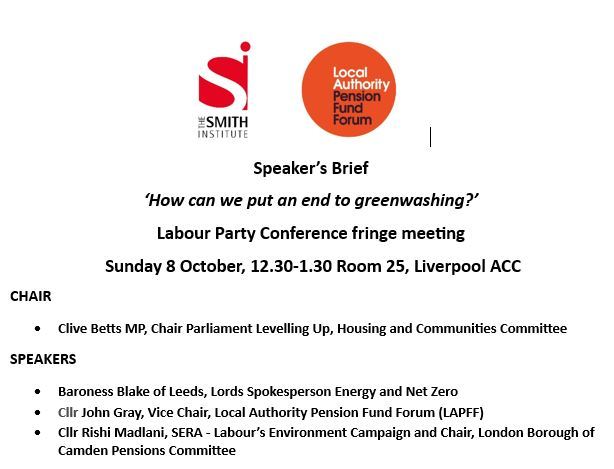
How can we put an end to greenwashing? Labour Party Conference fringe meeting - Sunday 8 October, 12.30-1.30 Room 25, Liverpool ACC


 CHAIR

·        Clive Betts MP, Chair Parliament Levelling Up, Housing and Communities Committee

SPEAKERS

·        Baroness Blake of Leeds, Lords Spokesperson Energy and Net Zero

·        Cllr John Gray, Vice Chair, Local Authority Pension Fund Forum (LAPFF)

·        Cllr Rishi Madlani, SERA - Labour’s Environment Campaign and Chair, London Borough of Camden Pensions Committee

BACKGROUND

There is widespread concern and public anger about companies making misleading and sometimes false statements about their environmental credentials. The issue is also on the radar of regulators and governments with growing interest about the use of terms and labels such as ‘sustainable’. Although interventions are starting to be made will they be enough to guard against the dangers that greenwashing poses?

For government, such dangers include delayed action to meet the goals of the Paris Agreement and avoid the worst effects of climate change. It also poses significant risks to our financial system and for investors. Unclear or misleading disclosures from companies could mean risks are masked and action is not taken by investors through their stewardship activity. Equally, misleading financial products also carry with it the risk that capital is misallocated while also undermining confidence in green products and sustainable investment.

The fringe event will discuss what more needs to be done nationally and internationally to improve disclosures and taxonomies and tackle greenwashing? And in the UK, what roles should government, councils, investors, companies and civil society play to end greenwashing?  

As the event is open to all people attending the conference it will not be held under Chatham House Rules.

FRINGE HOSTS

The event is supported by the Local Authority Pension Fund Forum (LAPFF), which represents the interests of 87 UK public sector (LGPS) pension fund members and seven Pools with combined assets of over £350bn. LAPFF promotes the highest standards of corporate governance to protect the long-term value of local authority pension funds. It does so primarily by engaging some of the world’s largest companies on environmental, social and governance issues.

The Smith Institute, an independent, not-for-profit think tank, is the co-host, providing the secretariat for the fringe event.

CONTACT ON THE DAY Paul Hackett

Picture https://lapfforum.org/engagements/were-going-to-need-a-bigger-planet/

Thursday, February 23, 2023

Local authority pension fund investment in affordable housing

This meeting of the APPG for "Local Authority Pension Funds was focused on local authority pension fund investment in social and affordable housing. To address the issue and whether there is a case for doing more, the event heard from four speakers: Cllr John Gray (Vice-Chair, Local Authority Pension Fund Forum); Paddy Dowdall (Assistant Executive Director at Greater Manchester Pension Fund); Helen Collins (Head of Affordable Housing, Savills); and John Butler (Finance Policy Lead, National Housing Federation)". Chaired bt APPG Chair, Clive Betts MP.

Check out YouTube of yesterday's panel debate/Q&A. An interesting panel and some great questions. Hopefully, my "ums" and "ers" were not too annoying (and to my continuel surprise on video my accent is still so northern/scouse after all these years down south). 

My message was that Council pensions funds can invest in so called "Affordable" Housing and get a appropriate return from sub market (60-80%)  rents which are good quality, low carbon, well managed homes but low income families in high rent areas need social rents (40-50% of private rents) or they will spend their lives on benefits and in poverty. 

To provide social rents you need subsidy. In the main, this has to come from the government of the day. You cannot expect tenants to receive inadequate housing services from their landlord in order to provide subsidy to build new homes. 

I posed the question at the end of the debate on whether housing associations, advisors and "for profit" provisors, understand that in all probability, in 18 months time or so, there will be a new government in power (not taken for granted for a moment) which may be quite different from the one in power for the previous 15 years? I think not. 

Friday, February 03, 2023

Local authority pension fund investment in affordable housing: is there a case for doing more? APPG 22 Feb 23


I am speaking at this virtual APPG event and looking forward to debating this key topical issue. Can local authority pension funds invest in "affordable" homes and still make an appropriate return? 

The terms "affordable" and of course "social" housing are in my view misused and arguably meaningless. Sub market rents are obviously better than market rents but very often they are "unaffordable" to so many in housing need. 

The Government interference into investment decisions and governance by Local Authority pension funds is also of concern. Will they try and force funds to invest into possible vanity infrastructure projects?  

While I believe that residential housing can be a very appropriate asset class (type of investment) for pension funds, if we want subsidised truly "affordable" or dare I say "social" rents (40-50% below most market rents) then we need subsidy from someone to bring rent levels down. This is not rocket science.

It is not only about rent levels but if you provide homes you also have to consider housing management standards, benefit allowances, security of tenure and meaningful resident participation.


ONLINE EVENT – REGISTER HERE

SPEAKERS

Paddy Dowdall (Assistant Executive Director at Greater Manchester Pension Fund)

Helen Collins (Head of Affordable Housing, Savills)

Cllr John Gray (Vice-Chair, Local Authority Pension Fund Forum)

John Butler (Finance Policy Lead, National Housing Federation)

Chair: Clive Betts MP

I am delighted to invite you to attend the next meeting of the APPG for Local Authority Pension Funds which will focus on local authority pension fund investment in affordable housing.

Local government pension funds have steadily increased their investment in place-based impact investments, which include both new and refurbished affordable housing. Most of the investment - from build to rent and shared ownership to temporary accommodation and specialist housing - is through co-investment partnerships and special purpose delivery vehicles with investment companies, charities and private and social housing providers.

Some have called for LGPS funds to further scale up investment in alternative assets and invest more in affordable housing. The Government is also calling on the LGPS to increase local investment and the chancellor has stated that the government will consult on requiring LGPS funds to consider illiquid asset investment opportunities.

This Zoom event will discuss what has been achieved and what more could be done to maximise investment opportunities. It will examine recent experience and best practice and explore the constraints and barriers to investing in affordable housing.

This meeting will be held online, if you want to attend please register here.

Best wishes

Clive Betts MP

Chair, APPG for Local Authority Pension Funds

Sent by the Secretariat of the APPG for Local Authority Pensions Funds which is sponsored by the LAPFF

Sunday, December 12, 2021

LAPFF Conference 2021: Day One

Day One of the Local Authority Pension Fund Forum Annual (LAPFF) conference started with a welcome by our Chair, Cllr Doug McMurdo. 

First item was a blended panel on the Local Government Pension Scheme APPG (all Party Parliamentary Group) report on a "Just Transition"

With Chair, Clive Betts MP, Cllr Doug McMurdo, Sabrina Muller (Policy Analyst for Sustainable Finance, Paul Hunter (PIRC) and moderated by Cllr Glyn Caron (LAPFF Executive). 

The opening event is about the
Just Transition inquiry, with APPG Chair Clive Betts speaking about the findings & how investors can facilitate a #JustTransition through engagement. 

The need to take people along whilst tackling the #ClimateCrisis is essential. "We risk having no transition at all if it is not seen as just." Sabrina Muller of @GRI_LSE speaking about the overlooked factor of location when thinking about job creation & losses. It risks exacerbating existing #inequality between UK regions.

Paul Hunter with @smith_institute summarising the landmark study by the Local Authority Pension Funds APPG https://appglocalpensionfunds.org Investors are vital but can't do it all, government strategy is a must

Next was "How is Sainsbury Plc addressing Climate Change" with Mark Given (Chief Marketing Officer, Sainsbury Plc), Jo Harlow (Non executive director, Sainsbury Plc) moderated by Rachel Brothwood (LAPFF Executive). Who presented and took questions on how the 2nd largest retailor in the UK has a "Plan for Better". 

Then "Say on Climate" with a virtual presentation by Sir Chris Hohn (Founder of TCI Fund Management) moderated by Cllr Rob Chapman (LAPFF Executive). The no nonsense self made billionaire investor did not mince his words and made it clear that he expected companies to produce 5 year action plans on Climate change and not 2050 targets. He also told us asset owners to sack fund managers who fail on Climate change and ESG. 

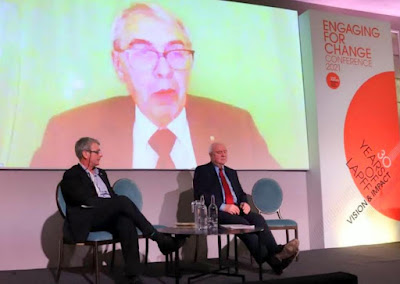
Final event of day was "30 Years of LAPFF  Vision & Impact"" with myself and my fellow Vice Chair of LAPFF, Cllr Robert Chapman, moderated by Brian Bailey.  A film showing our work over the past 30 years & how to bring about the best returns for local authority pension funds. "Run by us, for us". There was some interesting reminiscences about our history which are probably best kept within the LAPFF family. 

Hat tip @LAPFF feed

Monday, January 25, 2021

What does "Just Transition" mean in practice? We cannot deliver on climate change unless we have justice and fairness...?


Last Wednesday I attended the launch and first evidence session of the All Party Parliamentary Group for Local Government Pension Funds and its inquiry into ‘Responsible Investment for a Just Transition’. The meeting was chaired by Clive Betts MP. 

From the invite:-

"As you know, climate change is a threat to lives and livelihoods, and presents systemic risks to the economy and financial markets and to our future prosperity. Shifting to a net zero economy has the potential to create new jobs and drive economic growth. However, the benefits may not be felt evenly with some employees and communities bearing the brunt of industrial change. This not only risks creating economic hardship for some but also undermining support for the shift to net zero (my empathises).

Ahead of the UN climate change conference in Glasgow in 2021, the APPG inquiry will take evidence - and then compile a final report - setting out recommendations to UN agencies, national, devolved and local government, policymakers, business and investors, about how the risks that climate change poses can be avoided in a just way. Over the first half of 2021 the APPG will hear a wide range of perspectives on the issue and, in particular, answers to the following questions:

· What is a just transition is and why does it matter?

· What initiatives would help ensure a just transition

· What action you would like to see investors and government take on this agenda?

The APPG for LAPF believes that it has the opportunity to shape the national agenda on the just transition to a net zero future, and wishes to hear from as many voices as possible".

In response to a question what Local Government Pension funds can practically do to support "Just Transition" I suggested that they should support actively engage with companies they own to ensure that they follow the International Labour Organisation (UN) principles on Trade Union recognition and collective bargaining. No justice No Transition.  

Sunday, December 31, 2017

Why Local Authorities need "honest serving" men and women with the tools to ensure effective scrutiny


I have just been re-reading an excellent hard hitting report published earlier this month by the Select Committee on Communities and Local Government.

The Select Committee examined the grossly inadequate scrutiny arrangements in many Local Authorities. The deaths in Mid Staffordshire hospital and child sex abuse in Rotherham Council were given as examples of failures in scrutiny.

"Clive Betts, Chair of the Communities and Local Government Committee, said:

Scrutiny is marginalised at too many local authorities, which in extreme cases can contribute to severe service failures, letting down council taxpayers and those that rely on services.

Scrutiny of those in power is a vital part of any democratic system and has huge benefits for all. We are calling on the Government to strengthen guidance to make overview and scrutiny committees truly independent of those they are charged with holding to account and to make sure the process is properly funded and respected.

Only by rebalancing the system and ensuring scrutiny is held in high esteem will we see better decisions and the outcomes that residents who pay for council services deserve."

Clive calls for a much needed change in culture which is welcome but to be honest this will need Government action since many Councils (not all) dominated by strong Executive models do not believe in Scrutiny and deliberately block it.   While there are many "honest serving" Councillors from all political parties up and down the Country trying to properly scrutinise their Executive this report reflects their frustration. 

I think that there are many lessons to be learnt from this report for my own Council, Newham. However we are not the only one with inadequate scrutiny arrangements. 

Report recommendations 

1.That overview and scrutiny committees should report to an authority’s Full Council meeting rather than to the executive, mirroring the relationship between Select Committees and Parliament. 


Agreed. Reports are sent in Newham Council to the Executive or "via the Executive". 

2.That scrutiny committees and the executive must be distinct and that executive councillors should not participate in scrutiny other than as witnesses, even if external partners are being scrutinised. 

Agreed. In Newham executive members are allowed to vote for Scrutiny Chairs. Also, Executive members take part in Audit Committee and the Investment & Accounts Committee (and even chair both Committees!). 

3.That councillors working on scrutiny committees should have access to financial and performance data held by an authority, and that this access should not be restricted for reasons of commercial sensitivity. 

Agreed. Even Scrutiny Chairs are blocked from receiving "sensitive" financial information (for example, the report on £52 million loss on the London Stadium deal.) The Executive decides if and when information is realised. 

4.That scrutiny committees should be supported by officers that are able to operate with independence and offer impartial advice to committees. There should be a greater parity of esteem between scrutiny and the executive, and committees should have the same access to the expertise and time of senior officers and the chief executive as their cabinet counterparts. 

Agreed. This doesn't happen in Newham and many other Councils. Executive members have refused to attend Scrutiny meetings in the past and requests for Officers to attend have to be made via the Executive. 

5.That members of the public and service users have a fundamental role in the scrutiny process and that their participation should be encouraged and facilitated by councils.

Agreed. Recently the public (and media) were banned from attending (never mind participating) in the Newham Council Fire Safety in Tower Blocks scrutiny. 

6.That overview and scrutiny committees should be given full access to all financial and performance information, and have the right to call witnesses, not just from their local authorities, but from other public bodies and private council contractors. They should be able to follow and investigate the spending of the public pound. 

Agreed. See 3 above. Council special purpose vehicles (Local authority trading companies etc) provide services and control £ billions of assets and need to be fully scrutinised.

7.That the DCLG works with the Local Government Association and the Centre for Public Scrutiny to identify councils to take part in a pilot scheme where the impact of elected chairs on scrutiny’s effectiveness can be monitored and its merits considered. 

Agreed. As long as this doesn't mean things are kicked into long grass. 

http://www.parliament.uk/business/committees/committees-a-z/commons-select/communities-and-local-government-committee/news-parliament-2017/scrutiny-committee-report-17-19/

I have other concerns as well such as how committee members of Scrutiny are appointed in the first place and scrutiny arrangements being subject to political whips. I will be sending this article and links to the Chair of Newham Overview & Scrutiny and ask to meet the Committee to discuss the report and its recommendations.  

Monday, October 30, 2017

APPG Local Government Pension Funds (and the pitfalls of infrastructure investment)

Last week I attended an evening meeting of the All Party Parliamentary Group on Local Authority Pension Funds chaired by Clive Betts MP.

Before the meeting started I had a robust but interesting exchange with a policy expert on Local Authority Housing companies. I am really worried about such investments but promised to read his paper and then meet.

At the meeting itself the guest speaker was National Infrastructure Commissioner, Julia Prescott, who gave an upbeat presentation on the many opportunities offered to LGPS pension funds by infrastructure investments. I am generally a fan of pension funds investing in in long term infrastructure projects but in the Q&A that followed, I was reminded of some of the challenges, in particular, those facing local government pension investments in this asset class.

In response to a question, Julia gave the example of funds investing in a future Silvertown tunnel in East London in a positive light when obviously she was not aware of the huge political opposition to a such a tunnel locally and the environmental risks and reputational damage that any investor in a tunnel would face, especially if a local authority pension fund.

I had to leave early for another meeting so I did not have the chance to ask a question but I suspect that the new London wide Council Pension Collective Investment Vehicle (CIV) would face enormous problems investing in such a project that many think would result in the carbon monoxide gassing of children.


Sunday, July 19, 2015

How banks are ripping off Councils and what to do about it

This post was published on LabourList today. Tomorrow (20 July 2015) at 4pm the Select Community on Communities Local Government will hear evidence from the Channel 4 Despatches programme and their expert witnesses.

"This article is written by Cllr John Gray and Cllr Rokhsana Fiaz

As Newham Councillors we were horrified to watch the Channel 4 Dispatches programme ‘How Councils Blow Your Millions’, which was broadcast last week.  It is astonishing that nearly a decade after the Banks nearly destroyed our economy with their dishonesty and greed, they have been caught out yet again ripping off taxpayers; and in our case hard-working Newham residents.

 This time they are stealing millions of pounds every year in high interest charges for mis-sold and even illegal 70 year loans called LOBOs.  This is at a time when Newham, one of the poorest councils in the country, is facing savage cuts to its budget.  LOBOs are toxic loans, which rely on a City form of financial gambling called derivatives. The dice in LOBOS is rolled almost completely in favour of the Banks. Councils, who are deceived with the complexities of such financial products, signed up to these loans at fixed interest rates which they have to keep on paying even though interest rates have dropped like a stone to historical lows. If interest rates go up then the Banks can raise the rate on the LOBO or they can demand repayment.

It has been estimated that Newham pays an extra £13 million in interest payments per year on our portfolio of £563 million worth of LOBOs. This is over a £1 million per month or £250,000 per week. Newham are paying nearly 8 per cent on some of its LOBOs, while nowadays local authorities can get loans from the Government for 1-1.5 per cent. It would cost Newham hundreds of millions of pounds in so called ‘break clauses’ if we tried to repay the money early.  Nationally, Channel 4’s Dispatches estimate that councils up and down the country are paying £163 million extra per year on £15 billion of LOBOs.

So what can we do about this? It was good to hear Clive Betts, chairman of the parliamentary committee, which scrutinises local government, call for an inquiry by the regulator into the behaviour of the banks, but this is perhaps shutting the door after the horse has bolted.

Instead there must be a collective approach by all councils that have been ripped off.  As Newham councillors, we have been investigating LOBOs for several months and have spoken to a senior City law firm that specialise in suing Banks and other financial institutions. They have told us that we have a case for mis-selling and for having the LOBOs set aside because they are in fact derivatives.
Councils are forbidden in law from using derivatives and therefore the loans are what is called “ultra vires” and should be discontinued. Hammersmith and Fulham Council were able to this in the 1980s when they got involved in similar derivatives mis-selling scandal.

This legal fight will cost money since the Banks always contest such things in the first instance and they have long pockets funded of course with our money.  That is why we should share the burden amongst Councils affected. Labour Councils up and down the country who are especially affected by the LOBOs scandal, should be writing to the Local Government Association and urging them to take the lead on this.

The only alternative is to do nothing and keep on paying millions and millions of pounds that we haven’t got. That is not an option when hard working residents across the country face the prospect of local services being diminished because of local council budget cuts driven by central government’s austerity drive.

John Gray and Rokhsana Fiaz are councillors in the London Borough of Newham"

Friday, January 24, 2014

Local Government under Labour - Setting the Agenda

On Wednesday evening I went to the Local Government Association (LGA) headquarters in central London for the launch of a new report on the future of Councils under a Labour Government.

Paul Hackett from the Smith Institute opened the meeting and noted that we were in Bevin Hall in what use to be "Transport House", the former national offices of the T&G union.  There must be various labour movement ghosts of the past in this room and building.

Paul hoped that this report will help bring together Labour Councils and the Parliamentary Labour Party. 

Clive Betts MP was first speaker. He thought that after the the fundamental attack on local government by this present government we cannot just go back to the way things use to be. There is also a disconnect between the political class and those we serve that has to be addressed. 

Labour needs to think in opposition now since we will be too busy when in government.
 
Next speaker was Hilary Benn MP, the Shadow Secretary of State for Communities and Local Government

Hilary thought that there is a struggle between local and central government. In the NHS we need national standards but there is an appetite for change for what local government provides. 

Interestingly he thought that the referendum on independence in Scotland will settle the Scottish Question but then the English Question on decentralisation will have to be answered. 

He talked about the crisis of confidence in our politics and the failure of consumerism, where far too many people think they can just sit back and do nothing but moan about the way things are run and don't realise they need to contribute. 

He ended by stating his belief that the tide is flowing towards real localism.

Cllr Lib Peck, the leader of Lambeth Council spoke about canvassing and speaking to people who said they "don't do voting". She wanted to ask them "what bit of voting do you not get?". 

The next Labour government needs to be bold. Emphasis the core values of public service. Councils need greater income raising powers, the ability to borrow and planning powers to get rid of too many payday loan and betting shops.

Final speaker was Cllr Sir Richard Leese, Leader of Manchester City Council. He asked what Labour authorities wanted to do? They want to encourage economic growth and jobs. End social determination but not by the tools of the past. Instead of national programmes there should be  devolved economic development.

I asked a question to the panel that a future Labour government needs to trust Local Authorities with taxation and spend. I appreciate there is a battle with our Treasury team over expenditure but times have changed and in the Party we have largely got rid of out trot head bangers who wrecked local government in the 1980s. We can only get rid of the centralised nanny state if you trust the people to hold councils to account for their money.

Hilary responded by saying that while he wished that there was a political consensus on income raising for local authorities there is currently not one.

There followed a wide range of interesting questions and answers. I think that it is fair to say that there was a consensus about the need to devolve real power from the centre and a wish that Labour made its mind up quickly before 2015 and if elected, took no prisoners and got on with things from get go. 

Check out of course, the excellent Chapter 10 of the report: "Troubled families in troubling times" which just happens to be written by my local MP, Lyn Brown, Shadow Fire and Communities Minister :)