Showing posts with label Gallipoli. Show all posts

Sunday, November 09, 2025

Remembrance Sunday in Portsmouth 2025


Early on the Sunday morning I went to a Royal Navy service at the Memorial in Southsea remembering the 25,000 sailors killed during World War One and World War Two, who were buried at sea and had no known grave. My Taid (maternal Welsh Grandfather) Frederick Matthews, MC RNVR, served in the Royal Naval Division 1915-1918. It was a very moving service. 

Afterwards I finished off my visit to the historic dockyard in Portsmouth (see earlier post) during which I visited HMS Warrior (built in 1860 by East London Iron workers, who later formed what became West Ham FC). See the photo in bottom right of collage of the pay differentials between the Captain of the Warrior and ordinary seaman.  It was about 20x as much per day. 

Pretty shocking but certainly a lot less than the current West Ham FC football player gets today compared to average Newham residents wages nowadays. 

I then toured the bombardment ship HMS M33 (centre) which is one of only 3 British ships to survive from World War One. It first served in the Gallipoli campaign, which my Grandfather, also took part in and as I clambered over the ship, I wondered if at the time he had seen it or heard its guns in action. 

Next I visited the National Naval museum followed by another boat tour to the Submarine museum at Gosport and did a quick tour of the second world war sub HMS Alliance, the first ever British sub HMS Holland and the museum.  

I missed out on the Explosion and Firepower Museum and boat trip. Next time... 

Sunday, June 12, 2022

Frost bite in Gallipoli


Last week I was in Malta on holiday with Gill staying in a rented house in Pieta, a suburb of the capital Valletta. I will post another time on what a truly wonderful place Malta is to visit. 

By coincidence, just across the road from where we were staying was a Commonwealth War Graves cemetery.  Wherever I go, I always try to go and show my respects to these graves. 

The cemetery was as usual, kept in immaculate condition and walking along the graves and reading the inscriptions. There were many very sad and moving stories about so many young victims of the first and second world war, who were buried here and those who died in accidents or illnesses during the interwar garrison years.

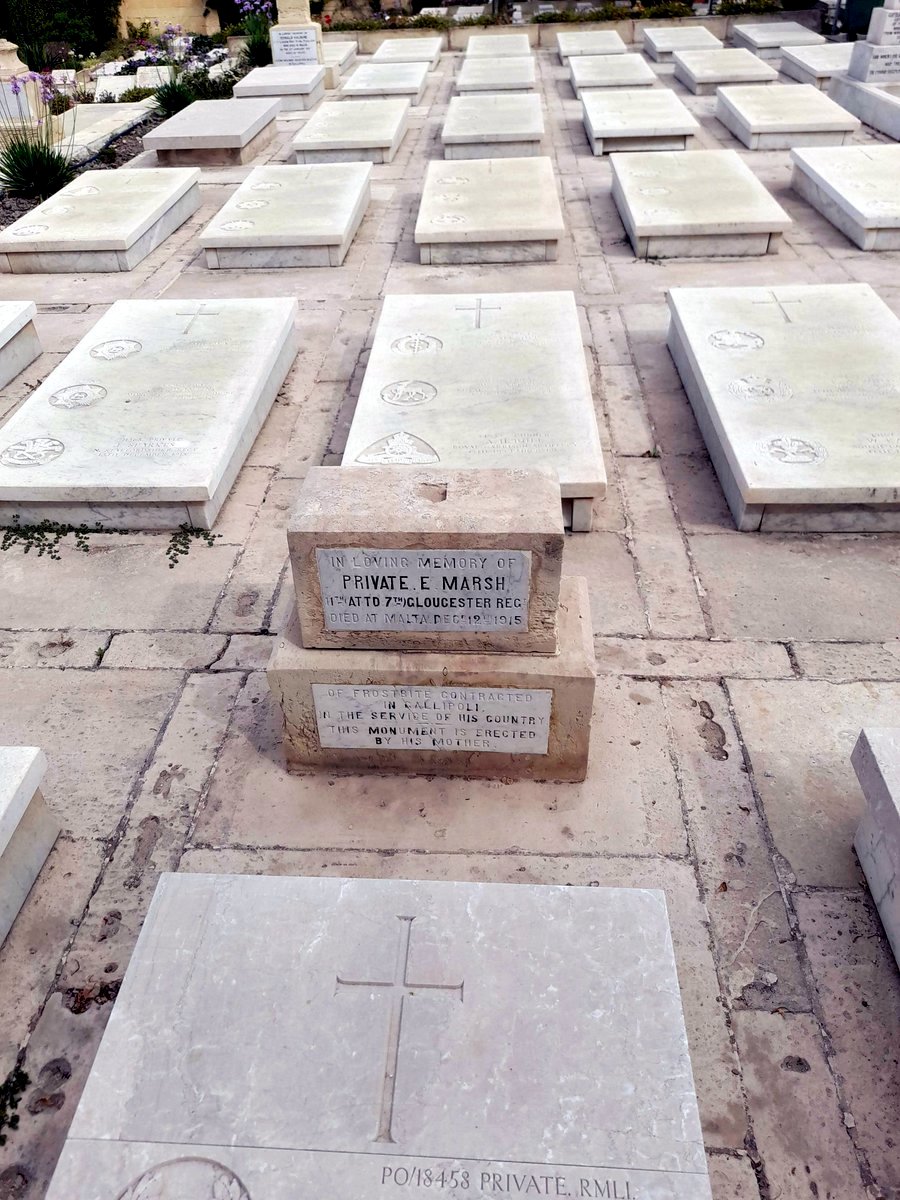
I was struck by one memorial to Private E (Edwin) Marsh (see main picture) from the 7th Gloucester Regiment who "died in Malta on Dec 12 1915 from Frost Bite contracted in Gallipoli in the service of his country. This monument is erected by his mother".

Edwin was before the war a South Wales Coal Miner and died of gangrene to his feet from frost bite 

My maternal Grandfather (Taid in Welsh) Frederick Matthews, was also from South Wales (he was a  steel worker) and fought in Gallipoli (Royal Naval Division) and I knew from military records that he had been evacuated from that front to a hospital in Malta on Jan 1 1916 suffering from frost bite to his feet. Malta at the time was turned into a vast military hospital for all the many wounded from Gallipoli. 

He was lucky and survived and when he eventually returned to fight with his unit in mainland France, he was awarded on 10 June 2017 a Military Cross for "conspicuous gallantry" by attacking enemy positions and capturing prisoners. Incredibly he survived the whole war. 

These sort of things must make you be conscious of the role of chance or luck in life. It could have been Edwin who survived the frost bite and Fred who didn't. In such case I would not be here and there is a tiny probable chance that Edwin's Grandson, could have come on holiday and also pondered on Fred's grave in Pieta. 

Friday, May 08, 2020

VE Day: Sgt Fred Matthews and Sgt John Gray


Both of my Grandfathers served in the Second World War. My maternal Grandfather ("Taid" in Welsh) Fred Matthews was a sergeant in the RAF See his discharge papers above. He had also managed to live through the carnage of Gallipoli and the Western Front in the First World War (during which he had been decorated with a Military Cross)

My paternal Grandfather (yet another John Gray) was also a sergeant but in the British Army for the whole of World War 2. He had been a Territorial soldier before the war and was one of the first to be called up. However, apart from knowing that he served in a Scottish anti-aircraft regiment,  I know nothing about his wartime service. Family folklore is that he may have been stationed in London during the Blitz and that he was part of a Unexploded Bomb (UXB) team.

I have finally downloaded the forms to apply to the Army records office for a copy of his service records.

I wonder how both of them celebrated VE day 75 years ago? Now sadly too late to ask them.

Thinking of both of them today and their comrades. 

Sunday, July 19, 2015

100th anniversary of my Grandfather arriving at Gallipoli

According to this history of the "Hawke Battalion" Royal Naval Divison (RDN) by Douglas Jerrold, my Grandfather ( Taid in Welsh) Sub-lieutenant, Frederick Matthews, first joined them on active service a 100 years ago yesterday on 18 July 1915.

The Battalion was "dug in" occupying trenches at the Gallipoli beach head only a short distance from Turkish Army positions.

It was the height of summer and apart from insanitary conditions and disease there was constant shelling, sniping, attacks and counter attacks. The Battalion stayed until the allied retreat in January 1916.

My "Taid" was an apprentice in a South Wales Steel works before he joined the RND. He served in the Battalion throughout the war and also fought in France and Belgium. He later became a Captain and was awarded the Military Cross in 1917.

I will try and post in chronological order upon the major events that he and the Battalion experienced in the course of the War. While Gallipoli must have been a terrible experience, some of the battles that the Hawke Battalion took part in later on were far worse and completely horrifying. 

The family picture above is of my Taid (sitting on the left with arms folded)  in the trenches with an unknown comrade which the family believe is probably Gallipoli in 1915.

Tuesday, April 28, 2015

Midshipman George L. Drewry VC RNR

Yesterday morning I attended a Commemorative Stone Ceremony at the Cenotaph in Central Park, East Ham, Newham, London.

It was to mark the unveiling of the first of 5 paving stones to be placed at the Cenotaph to remember the heroism of five Newham residents, who won our nations highest military honour, the Victoria Cross, during World War One.

Forest Gate born, George Drewry, won his Victoria Cross age 20 during the Gallipoli landings on 25 April 1915.

The ceremony was very much a naval affair led by Hon Vice Admiral The Lord Sterling of Plaistow, GVCO CBE RNR. There were other Royal Navy personal, Sea Cadets and a Royal Marine Bugler who played "The Last Post".

The Rifles, the British Legion, Police, Council, faith groups, local School children and residents were also there to honour Midshipman George Drewry.

In a nice touch they had a modern day Royal Navy Midshipman (this is the most junior Officer rank) give the account of the incredible heroism by George Drewry, who despite bring wounded, repeatedly risked his life under heavy enemy fire to enable troops from his ship to land at Gallipoli.

Check out the tale at Newham Story.

I hope to attend all the ceremonies commemorating Newham residents who won the Victoria Cross during First World War. 

The ceremony yesterday was special to me since (as already mentioned in this post) my Grandfather, Frederick Matthews MC, was also in the Royal Naval Reserve (RNR) and fought in Gallipoli.

Saturday, April 25, 2015

The band played waltzing matilda


Today is the 100th anniversary of the beginning of the First World War Gallipoli campaign.  The 8 month conflict was one of the most vicious of that war.

This song was written by Eric Bogle in 1971 and was today described by a good friend of mine (and who has a doctorate in History) as "the most powerful anti-war song I have ever heard".

Gallipoli is very important to Australians  and New Zealanders but British and French troops also served there. My maternal Grandfather, Frederick Matthews, fought there with the Hawke Battalion, Royal Naval Division. He arrived after the landing in July 1915. I will post further in July about him and his Battalion's experiences in Gallipoli and then later in France. 

Monday, February 09, 2015

A day with G Company 7 Rifles on Salisbury Plain

On Saturday I spent the day with 7 other Newham Councillors as the guests of G Company 7th Rifles Regiment, while they were training on Salisbury Plain, Wiltshire.

G Company is our local British Army reservist unit in Newham, based at Cedar barracks in my ward next to West Ham park. This trip had been organised by the one and only, Terry Paul, Cllr for Stratford ward.

The idea was to give local Councillors some understanding of what our reservist soldiers in the modern army have to go through. Terry and I had both been members of the "Territorial Army" (TA) when we were younger, so we had some idea of what to expect. But in our day the TA role was to support NATO against a Soviet Union invasion of Germany. Not to serve on hostile active service operations such as in Iraq or Afghanistan, which modern day reservists are normally expected to carry out.

We arrived at the Drill Hall at 7.45 and we were somewhat to our surprise were issued with combat overalls, waterproofs, Bergen's (rucksacks), 24 hour pack of rations, mess tin, cooker and steel helmets. Everyone was very welcoming and pleased to see us. We then drove by a minibus to Salisbury Plain which is a massive military training area and got off at at some disused farm buildings.

During the trip down the soldiers accompanying us were very honest and frank about their experiences while on active service. By coincidence one was born in Canning Town, a street away from where Terry was brought up while the other was his possible distant cousin. At the farm buildings we had a series of briefings about our day and were advised to put on all our warmest and windproof clothing.

G Company had arrived on the previous Friday evening and had spent the night sleeping out in the open and were carrying out reconnaissance training exercises all Saturday until about 2am the following day.  They were then planning a dawn attack on an "enemy" position on the Sunday morning.

We discovered why we had metal helmets as we climbed into our army cross country heavy goods vehicle to be transported to our first site. I used to be a military HGV driver and in my day (an expression which makes me feel pretty old) there was only a bench either side of the rear of the HGV that we were expected to sit on as passengers. Nowadays you have to wear a metal helmet and sit in racks with an airplane style safety harness. Going across rough country you appreciate wearing a helmet and harness.

After about 15 minutes we stopped at a wood near a training ground, got out and walked to the company machine gun platoon exercise. The platoon were practising coordinating and firing 7.62mm General Purpose Machine Guns (GPMG)

We then spoke to the machine gun teams about what they do and examined the GPMG and their SA 80 rifles. The machine guns, the tripods and belts of ammunition were so heavy you could not imagine carrying them as well as your other military kit.

Afterwards we went into a nearby wood which had been the sleeping area for the company the previous night and had a fantastic presentation by a rifleman on how to cook lunch from our "24 hour ration packs".  It was very cold in the wood and we all enjoyed the hot food even if it took us a little while and a bit of trial and error. Hot food is a brilliant pick-you-up that you only really appreciate if you are very cold.

We then went off to observe a section of the Rifle platoon carry out different patrolling exercises and formations. If a patrol was attacked they practiced firing back and maneuvering either to attack or move away. This is what infantry soldiering is all about. If you come under fire on a patrol you know what to do instinctively since you have practiced this time after time after time.

It was sobering to think that some of the more experienced soldiers present had actually done this in real life and had carried out these exercises while under fire from live bullets.

Finally, we drove back to the base in the HGV and then had a debrief with a cup of hot coffee then left to drive home to East London. All of us fell asleep on the way back. At Cedar barracks we dropped off our kit and changed back into our normal clothes.

I think that every single one of us Councillors really enjoyed the day and found it fascinating and different but also the friendliness and hospitality shown by everyone towards all of us was simply stunning. Thank you very much G Company 7 Rifles. You did us proud.

Afterwards some of us went to the Black Lion in Plaistow to give a toast to 7 Rifles and wish them well with the rest of the exercise.

I must admit that I was also thinking that day of my Grandfather, Frederick Matthews, who in 1915 did his basic military training in the Salisbury Plain and then went on to command a machine gun platoon in Gallipoli and later in the trenches in France. Did he practice such military skills in these very same fields and valleys 100 years ago?

Monday, August 04, 2014

4 August 2014 - 100th anniversary of the start of World War One

This morning at 11am I went to the Cenotaph at East Ham Central Park for a Newham Council ceremony to mark the 100th anniversary of the beginning of World War One.

A British Legion representative laid the first wreath followed by the Mayor and representatives of the former boroughs of East and West Ham.

One lovely spontaneous touch was as the wreaths were being laid, a passerby stopped and started singing a beautiful lament to the fallen "Sleep on Beloved, Sleep on and take your rest".

My Grandfather, Frederick John Matthews MC, Royal Naval Division, fought in the First World War. On 5 August 1914 he was still an apprentice "mechanical engineer and draughtsman" in a South Wales Steel works. He left to join up on 2 September 1914 and returned to work (briefly) in January 1919.

I hope in the coming years to follow in his footsteps a hundred year later, starting off next  year at Gallipoli in Turkey then the trench battles of France and Belgium.

hat tip picture Cllr Ayesha Chowdhury,

Sunday, April 10, 2011

Captain Frederick John Matthews MC: Royal Naval Division

This is the scanned picture of my Teid (my Welsh maternal grandfather) which I received yesterday morning.  In the beginning of the First World War there were too many volunteers for the Royal Navy. So Winston Churchill created the Royal Naval Division which fought on land but retained Naval ranks and traditions.  

"It was regarded as a highly efficient fighting force and played a prominent part in some of the bloodiest battles of the war".

Teid had volunteered to join the Navy in 1915 and was sent to the RND.  He eventually became a Captain (temporary wartime commission RNVR). He fought in Gallipoli and on the Western front in the First World War. In 1917 he was awarded a Military Cross for attacking and capturing a German Machine Gun post and taking 40 prisoners.

After the War he became a Regular Warrant Officer in the Royal Welch Fusiliers and in the Second World War he was a Warrant officer in the Royal Air Force.  So he served in all three Armed Services.  I was 9 when he died in 1971.

This picture is important to me.  I have waited a long time to get a copy.  It was obviously displayed in pride of place in my grandparents' home in Denbigh, North Wales.  Together with the actual Military Cross and the Certificate of Honour from his hometown of Abercarn.  All my (seven) maternal aunties and uncles also had copies displayed prominently in their homes.  I am sure that many families can relate to this experience.

However, equally important to the Mathews family, Teid, was also known as someone who would stand up for ordinary people in the local community.  Someone who write and send letters to Landlords, employers, the Bank, the Council or whoever - on behalf of those who could not express themselves in this way.

In our family we took pride in him representing ordinary working people as well in his bravery in Battle.

Saturday, November 01, 2008

A Tourist snapshot of Ataturk’s Turkey

Just back from a cheap “last minute” package holiday near Kusadasi, Turkey. I’ve never been to Turkey before, always meant to, but like many people, had been put off in the past by military coups, terrorism, Cyprus and Kurdistan etc.

The Mrs and I were just looking forward to escape the UK winter for a week with some sun and sightseeing. By coincidence on Wednesday, it was a National Turkish Holiday. “Cumhuriyet Bayrami , the day commemorates the proclamation of the Republic by Mustafa Kemal Ataturk in 1923.

In the run up to the day, practically everywhere you went you would see national flags with pictures of Ataturk. The hotels all had huge red Turkish flags hanging down from their fronts. All cafes, shops and restaurants would have his picture or poster fixed somewhere, usually you would look up and he would be glaring down at you from various directions.

On Monday we went into Kusadasi and walked up the hill to the huge statute of Ataturk that overlooks the harbour (see pictures). Many Turkish towns have similar such statues. The walk up went through some very poor areas but we were cheerfully greeted by families and young children without any of the hassle you find in the main shopping and tourist areas. A lesson somewhere no doubt? The view from the top was well worth the effort but the site itself was strangely neglected, vandalised and definitely unkempt.

On the Wednesday itself we went to Selcuk by Dolmas (local shared transport) which despite its proximity to popular tourist attractions is a really nice Turkish market town, no “English breakfasts” on offer. As we went into the town there was a parade of local children with bands and swirling Turkish flags. We followed them to a local school where the headmaster (or local Mayor?) gave a stirring speech which the children seemed to enjoy by regular cheering and clapping. They then wandered off so I assume the rest of the day was a holiday which might have contributed to a celebratory spirit.

There were huge banners of Ataturk hanging from the walls of the local castle and various city buildings. The cult of Ataturk felt very pre 1989 Soviet or even 1984-ish. It also did not seem (to me) a particular “joyous” day of celebration. There were a number of trucks driving slowly around the town with PAs playing loud martial “patriotic marching music”, some decorated with flags, some not. The characters manning these trucks (all men) seemed to be out of central Turkish gangster casting. Large big stomached blokes with bushy moustaches and permanent scowls who didn’t seem to appreciate my David Bailey impersonation by taking their photos. I suppose that in the past Turkish internal politics has been very, very (repeat very) violent and it is understandable they are suspicious but I thought that I stuck out a mile as a tourist. I also felt that they expected some sort of opposition or were making some sort of provocative stance? I didn’t ask what political party they were supporting but I assume they were right wing secularists.

The “Rough Guide” suggested that Selcuk has designated quarters for “settled Yoruk Nomads....Kurds and gypsies......socialising little with each other”. I tried to see if there were any parts of the town which were not displaying flags or posters. I assume that many Kurds are not impressed with the legacy of Ataturk? Neither Islamic fundamentalists. But it seemed that all areas flew the flag. Even if you did not want to celebrate you would stick out if you didn't so you could understand the reason why you had to "fly the flag". Or else?

Saying all this, it did overall seem to me that Ataturk is a national hero for the mass of Turks. His achievements are pretty amazing despite the obvious “but”.

He first came to prominence as a divisional general who helped defeat the First World War allied invasion in Gallipoli in 1915 (my "Taid" or Welsh Grandfather also fought in Gallipoli with the British Royal Naval Division), he later defeated the Greek, French and Italian Armies who were trying to dismantle Turkey, overthrew the 600 year Ottoman sultanate, emancipation of women, the abolition of all Islamic institutions and the introduction of Western legal codes, dress, calendar and alphabet, replacing the Arabic script with a Latin one. Nuf said?

When he introduced surnames in 1935 for Turks he choose the name Atatürk, meaning 'Father of the Turks'. He died on 10 November 1938.

Of course he was also a dictator who crushed opposition and ruthlessly destroyed opponents who he thought plotted against him and his vision for the future, whether that threat was real or imagined. His understandable obsession with national unity in 1923 meant repression for minorities in the years after and he legitimised the role of the Armed Forces in overthrowing civilian governments they did not like. In the end at the age of only 57 he drank himself to death.

We flew back last night from a 26C blue sky Turkey to a Gatwick Airport car park where I had to scrape the ice off the car windows. End of holiday.