Showing posts with label Brian Bailey. Show all posts

Sunday, December 12, 2021

LAPFF Conference 2021: Day One

Day One of the Local Authority Pension Fund Forum Annual (LAPFF) conference started with a welcome by our Chair, Cllr Doug McMurdo. 

First item was a blended panel on the Local Government Pension Scheme APPG (all Party Parliamentary Group) report on a "Just Transition"

With Chair, Clive Betts MP, Cllr Doug McMurdo, Sabrina Muller (Policy Analyst for Sustainable Finance, Paul Hunter (PIRC) and moderated by Cllr Glyn Caron (LAPFF Executive). 

The opening event is about the
Just Transition inquiry, with APPG Chair Clive Betts speaking about the findings & how investors can facilitate a #JustTransition through engagement. 

The need to take people along whilst tackling the #ClimateCrisis is essential. "We risk having no transition at all if it is not seen as just." Sabrina Muller of @GRI_LSE speaking about the overlooked factor of location when thinking about job creation & losses. It risks exacerbating existing #inequality between UK regions.

Paul Hunter with @smith_institute summarising the landmark study by the Local Authority Pension Funds APPG https://appglocalpensionfunds.org Investors are vital but can't do it all, government strategy is a must

Next was "How is Sainsbury Plc addressing Climate Change" with Mark Given (Chief Marketing Officer, Sainsbury Plc), Jo Harlow (Non executive director, Sainsbury Plc) moderated by Rachel Brothwood (LAPFF Executive). Who presented and took questions on how the 2nd largest retailor in the UK has a "Plan for Better". 

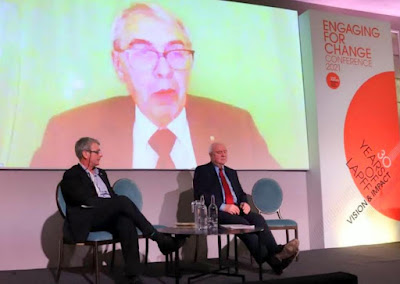
Then "Say on Climate" with a virtual presentation by Sir Chris Hohn (Founder of TCI Fund Management) moderated by Cllr Rob Chapman (LAPFF Executive). The no nonsense self made billionaire investor did not mince his words and made it clear that he expected companies to produce 5 year action plans on Climate change and not 2050 targets. He also told us asset owners to sack fund managers who fail on Climate change and ESG. 

Final event of day was "30 Years of LAPFF  Vision & Impact"" with myself and my fellow Vice Chair of LAPFF, Cllr Robert Chapman, moderated by Brian Bailey.  A film showing our work over the past 30 years & how to bring about the best returns for local authority pension funds. "Run by us, for us". There was some interesting reminiscences about our history which are probably best kept within the LAPFF family. 

Hat tip @LAPFF feed

Tuesday, December 10, 2013

The Future of the Local Government Pension Scheme: LAPFF 2013

The Government Minster for the LGPS had dropped out of appearing at conference this year (it was rumoured that he didn't want to be shouted at for the way that the consultation on merger was being handled - Surely not?) and Joanne Segars from NAPF and Chair of LGPS National Pension Advisory Board, who was suppose to replace him was ill.

So chair Brian Bailey now of PIRC, introduced a panel of what he called "three old codgers"-  himself, Terry Crossley (a former Civil servant responsible for the LGPS) and Cllr Kieran Quinn, to have a "chat" about the future of the LGPS.

They firstly discussed concerns about how sustainable the scheme was following the agreement of 2012. Especially mature schemes that had suffered the most in the recent revaluation.

Terry said he thought the current reform was rooted in the politics of the current Government Coalition. He was in the room when the LGA, unions and ministers agreed the deal and was suspicious since it was a big "ask" and a big risk in his opinion. A 1/49th career average scheme with no-one earning up to £43k paying any more?  How are the Hutton Report savings (£900 million per year) to be achieved? Increasing the contributions by staff was missed by the attempt to avoid further opt outs from the scheme.

Senior Firefighters in their scheme pay 17% of salary in pension contributions. Far more than senior managers in the LGPS (who to be fair, retire at a later age). Question mark on how long it can last? The 2016 revaluation is the most important. In 2019 the cost management process may mean that the Treasury in 2020 will insist in either an increase in contributions or reduced accrual (or only for new entrants?).

Kieran thinks that there will be continually uncertainty which none of us here have the answer yet but that the answer to increased costs could come from good investment returns (or of course cut the costs of running the LGPS?). 

Terry thinks LGPS 2014 saving are only £500 million pa. There will be problems with the reduction in numbers of active members as "maturation" occurs.

On the Governance side, Kieran thinks that the National advisory board is working well so far. The "call for evidence" on possible merger of LGPS produced many responses.  The new role of the pension regulator is currently unclear? We have to consider the role of non council employers in the scheme. He believes the role of trade unions and Employers working in partnership is very positive.

Terry is worried that that the National board might seek to be too ambitious. Elected Councillors are responsible for the fund. He believes that the role of local pension boards is advisory and only to scrutinise administrating authorities. (UNISON and others think he is wrong. If scheme members now bear the risk of poor investment then they must have an active say in governance)  He noted that there use to be 8 English local government regions. Is it possible to have 8 LGPS funds?

The treasury cost cap on employer pension contributions will be set next year by GAD (the government actuaries). The National Advisory Board meets on December 16th to consider the results from the "call for evidence".

Sunday, December 08, 2013

Social Impact Investing: LAPFF 2013

Brian Bailey, Chair of PIRC and former senior member of LAPFF speaking about the 5 large Local Government Pension funds (LGPS) that are investigating a possible £250 million Social Impact investment.

Cllr Kieran Quinn explained what is social impact investing. It is the use of repayable finance to produce social and financial returns. Such as health, well being, better employment and improved social problems.

LAPFF sponsored a report  in 2012 by the Smith Institute on such investments. I think that most people would think that this is a "good thing" to invest in something has has a financial and social return but there are "challenges".

Small investment funds mean relatively high costs in fees and supervision. It is more risky than conventional investment and there are possible conflicts of interest if you invest a Council pension fund in your own locality.

A shared service approach is believed to be the best way of overcoming these risks and the need to make sure that there is a commercial return and to pass due diligence. Watch this space.

I went to the GIIN investor conference in October on what they called "Impact Investment".

Hat tip LAPFF twitter for photo.