Showing posts with label PIRC. Show all posts

Tuesday, November 15, 2022

Mining and Human Rights: LAPFF Chair Returns from Brazil Tailings Dam Trip


Check out this press release by the Local Authority Pension Fund Forum (I am Joint Vice Chair) on the recent visit by our Chair to Brazil. Many thanks to Doug and our engagement partners, PIRC, for all their work during this important visit. 

Some Progress Noted but Lots of Work Still to Do

"LAPFF Chair, Cllr Doug McMurdo, returned from Brazil recently where he spent three weeks investigating the progress of reparations following tailings dam collapses in Mariana (2015) and Brumadinho (2019). This trip was part of LAPFF’s broader work on mining and human rights. The context for the trip is available in the mining and human rights report LAPFF published in April 2022.  The motivation for the trip reflects LAPFF’s view that social and environmental impacts by investee companies are financially material for investors.

During his trip, Cllr McMurdo met with communities affected by the 2015 Mariana and 2019 Brumadinho dam collapses. BHP and Vale own the Mariana Fundão dam through their joint venture operator, Samarco. Vale owns the Córrego do Feijão dam that collapsed in Brumadinho. Water quality and delays in house building in Mariana are the two major concerns cited by affected community members with whom LAPFF spoke.

After meeting with affected community members, Cllr McMurdo spent two days with the Chair of Vale and senior executives from the company. LAPFF extended an invitation to meet a BHP representative during Cllr McMurdo’s trip, but the invitation was declined by the company.

At the end of the trip, Cllr McMurdo met with a number of Brazilian investors led by ESG-focused asset manager, JGP Asset Management, with whom LAPFF has been partnering on this project for a couple of years. Collectively, the investor group worked with senior executives of Vale to set in motion a process to increase the pace and quality of reparations following the tailings dam collapses.

Quote from LAPFF Chair: “It is clear that Vale has taken steps to improve its corporate culture and its dam safety practices. LAPFF’s objective is to be a critical friend to the company in fostering better and faster delivery of required reparations and dam safety measures.”

The largest impediment to completing reparations in Mariana quickly enough and to an adequate standard appears to be the Renova Foundation. Vale, BHP, and Samarco – but no affected community members – sit on the board of this organisation which was established to provide reparations following the Mariana tailings dam collapse in November 2015. The Foundation has an overly complex structure, similar to that of a joint venture, and does not have adequate independence in its governance. Both shortcomings have led to poor and drawn-out execution of reparations.

Quote from JGP Asset Management: “Unfortunately, we cannot go back in time and avoid the two disasters that Vale was involved in. However, Vale can act today to become the reference point for an ESG standard in mining, a critical industry for the global energy transition. As investors, we keep engaged with the company on several fronts, but especially in corporate governance and relations with the communities where Vale has operations.”

Quote from Vale: “Vale is enhancing its dialogue and engagement with shareholders, communities and society, in order to act in greater alignment with their expectations. I was pleased to personally welcome LAPFF’s representatives in Brazil and to show Vale’s efforts on reparations initiatives and dam safety. I want to thank LAPFF for its feedback and I would like to renew our commitment to building a better company. It is a long way to travel and we will continue to act attentively in making Vale one of the safest and most reliable mining companies in the world.”


Saturday, October 08, 2022

Labour standards in the rubber glove industry

Last week I chaired a virtual webinar organised by PIRC and UNISON on Labour standards in the rubber glove manufacturing industry. There were 6 panel members located in Europe and Asia and an invited audience of  some 50 industry representatives, investors, trade unionists and NGOs. 

There was some dreadful horror stories of human rights abuses in many factories that produce gloves for the NHS (and which Local Government Pension Funds may also have investments in).  Hopefully there will be a follow on event soon. 

This was my introductory blurb. "Hello everyone and welcome to today’s webinar on labour standards in the rubber gloves industry co-organised by PIRC and UNISON.

Since the start of the Covid-19 pandemic, and the greatly increased demand for personal protective equipment, there has been an increasing focus on the medical rubber glove supply chain. Forced labour, poor conditions and other labour rights concerns have received considerable media exposure.

For investors there has been a bit of a rollercoaster ride. The share prices of manufacturers initially surged on increased demand, but public policy responses brought valuations back to earth. In particular the use of Withholding Release Orders by US Customs and Border Protection to address the use of forced labour had a major impact. In the future public procurement decisions by national and regional public sector buyers may become increasingly important. While the S in ESG is often the poor relation, and is given less scrutiny by many investors, in this case risks relating to poor labour practices has become financially material.

It’s also difficult terrain for investors to navigate, due to differing accounts of the situation on the ground. Companies have tried to improve. On some key issues – such as the use of recruitment fees – a substantial amount of money has been spent seeking to provide redress. Yet workers, activists and unions continue to raise significant concerns.   

In this webinar we will hear from a range of experts and organisations involved in improving standards in the rubber glove industry. In the first half we’ll be hearing about ongoing concerns relating to labour practices in the sector.


Anton Marcus –Trade Zones & General Services Employees Union

Andy Hall – migrant workers' rights advocate

Tom Grinter – IndustriALL

Then we’ll take some questions. You can put these either in the chat or use the Q&A function.

In the second half of the webinar we’ll focus on some of the policy responses, including public procurement, and the business-led initiative the Responsible Glove Alliance.

Pauline Gothberg, Swedish County Councils and Regions

Nusrat Uddin, Wilson's solicitors

Anna Pienaar, Executive Director, Responsible Labor Initiative & Responsible Glove Alliance

Then we will have the opportunity for further questions.

To start us off, Tom Powdrill from PIRC is going to give a very brief introduction to its work on this topic...

(I am moderating another Labour Standards investor event on 18 October "LAPFF & IndustriALL Webinar: Employment injury insurance for garment workers in Bangladesh. Registration here)

Thursday, September 29, 2022

"Levelling up net zero:How can we invest in a fair and just transition" Fringe #Lab22


 This is the presentation I gave on Monday at the LAPFF/the Smith Institute fringe alongside panel speakers, Olivia Blake MP and Professor Nick Robins. Chaired by Paul Hackett. Many thanks to Paul Hunter from PIRC for speaker notes.

"First for context a bit about me, I am John Gray a councillor in Newham, East London and Unison rep and through these roles I have been involved in local government pensions for a number of years.

This includes being vice-chair of the Local Authority Pension Fund Forum (LAPFF), which is a membership organisation representing over 80 public sector pension funds and investment pools.

Together our members have over £350 billion of assets under management and have holdings in many of the largest companies within the UK but also globally.

And across our pension funds, there are millions of scheme members who serve or have served our communities who rely on our investment funds to provide a pension in retirement. I included.

The role of LAPFF is to protect these pension fund investments by engaging with investee companies on responsible investment issues, including around climate and social issues such as employment standards and human rights.

So why I am here and why as investors are we interested in issues around the environment, levelling up, and social issues associated with the transition to net zero?

For us these issues are not just a matter of good corporate behaviour for its own sake, but also protecting the pension funds that provide for millions of people.

To give an example of what I mean, LAPFF recently visited Brazil to meet communities and discuss with one of the world’s largest mining companies the mining disasters that have happened in South America over the last decade.

These disasters were a human tragedy. Over the period a series of (what are called) tailing dams used in the mining process have failed, submerging people under a wave of water and mud with a significant loss of life, livelihoods decimated, and communities destroyed.

It is impossible not to be affected by stories we have heard by community members.

However, while quite clearly primarily a human disaster it is also an issue for us as investors. We want to act as long-term responsible investors. And when disasters like these happen it not only undermines our purposes as responsible investors, it also comes at considerable costs with reparations and the clean up running into multiple billions of pounds.

And when you look at this example, one of the most galling components was that it was avoidable – safety concerns were raised by workers and communities before the tragedies but were ignored.

I wanted to start with this example not only to show what I mean by the importance of environmental, social and employment standards for long-term investors but also because the mining sector provides a very good case study for today’s discussion.

It is an industry in transition – it is having to power past coal as part of our move away from carbon intensive energy sources and industrial processes.

And it is vital sector for so-called transition minerals – cobalt, lithium, nickel and the like – which are all needed in green technology such as electric vehicles.

Without mining activity for such transition minerals, decarbonising our economy won’t be possible and as long-term investors we face significant market-wide risks from climate change. And at an individual company level we run the risk of being invested in stranded assets and in firms left behind as regulation ratchets up.

In the mining sector we also have a pretty good case study in the UK context of how not to do an industrial transition. We know all to well what happens when we don’t consider the implications for workers and communities and social dislocation that can follow. Olivia mentioned the coalfields in South Yorkshire in the 1980s, I was brought up in industrial North East Wales at the same time while we are of course now in Liverpool, which took decades to recover.

And in the case of mining disasters, the lack of engagement between companies and their stakeholders that I mentioned creates their own set of risks.

Although I have used mining as an example, the transition is likely to have significant impacts across a whole range of sectors – energy, utilities, manufacturing, housing, agriculture, transport – to name a few. While mining in the UK may have declined over recent decades, these other sectors are all large industries in the UK and are all now in period of change.

And in this period of change, if we repeat the mistakes of the past and ignore the social implications of the industrial transition, we will almost certainly create deep-seated opposition to climate action. This morning we woke up to the news that a far right government has been elected in Italy in part due to such fears.

This includes potential opposition within specific communities because of the geographical dimension to achieving net zero.

Carbon intensive sectors are often located in the least wealthy places and regions and so are facing the biggest adverse impacts of the transition.

But, it’s not all doom and gloom. The transition comes with risks but there are real opportunities. We have the chance to create new jobs, support local growth and bolster efforts to level up the country while also helping to avoid the worst effects of climate change.

What this does demand is careful consideration about how we can best support communities as we decarbonise our economy. How we can level up net zero.

As investors we have a role in this: Scrutinising and engage investee companies on how they are approaching the social implications. Understanding how they are engaging workers and communities on industrial change, their plans for retraining and redeploying staff as jobs change and how they are supporting the communities in which they operate through the transition.

But investors and companies can’t do it alone. Government clearly plays the primary role, including in supporting and demanding us to do more. That is why we supported an inquiry into a just transition run by the All Party Parliamentary Group for local authority pension funds and a copy of the report is on our website.

Much of what that inquiry heard suggests there has to be a firm commitment to a just transition from governments. In the UK context there is a strong case for a Just Transition Commission to bring stakeholders together and provide guidance, including on what interventions are needed to support local economies and communities over the coming decades.

As the levelling up white paper mentions, there could be a role for local authority pension funds to invest locally to support growth. But the feedback from our members is that this requires policy certainty. As long-term investors, without certainty it is hard to make local investments in the transition or understand the social implications.

There is also regulation that could help. It is a positive step that government recently introduced rules requiring large companies to consider the risks and opportunities they face as a result of climate change. These TCFD reporting requirements compel companies to disclose this information in a clear and consistent way so investors can understand their financial exposure to climate risk.

However, currently this does not have to include the social risks associated with the transition. Be it push back on their climate transition plans, workforce and skills issues of the transition, the impacts on stakeholders such as communities or managing reputational and operational risks with employers, consumers, suppliers or communities.

Considering the social implications is not an impossible task. Indeed, some companies are already starting to develop just transition plans. Energy company SSE, for example, have a just transition plan covering engagement with workers and communities, making a commitment to decent work and the creation of new low-carbon job, sharing value with communities and having a road map for an orderly and planned transition for their business.

Achieving that orderly transition is not a straightforward task.

We are all too aware of the pressures to water down environmental regulations in the face of the energy crisis.

And I think this an important point to finish on.

More broadly, in whatever role we play as investors, government, politics or civil society, if we don’t consider the social and economic impacts for communities of the transition to net zero, we will face opposition to climate action.

Preventing that ultimately demands that we all play our part, including businesses and the investment community, in ensuring the shift to net zero is part of the solution and not part of the problem when it comes to narrowing economic divides and levelling up the UK".

Friday, February 04, 2022

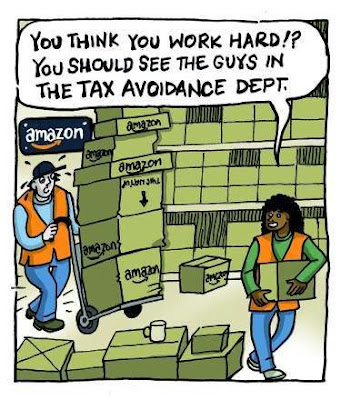
Amazon on tax disclosure webinar Feb 10

"Having supported the shareholder resolution at Amazon on tax disclosure, PIRC is holding a webinar to highlight a broader programme on Fair Tax.

The Greater Manchester Pension Fund & OIP shareholder proposal was the first resolution filed as part of our new investor initiative on Responsible Corporate Tax with CICTAR.

It will facilitate active engagement with corporations in sectors with a history of aggressive tax avoidance, as well as those with significant exposure to government contracts & dependent on healthy tax revenue for growth.

Join us to hear more about Amazon’s tax practices, the GRI Tax Standard and opportunities to get involved in the broader collaborative engagement on responsible taxation.

Speakers include:

• Dr Katie Hepworth, Responsible Tax Lead, PIRC
Jason Ward, Principal Analyst, CICTAR
Tom Harrington, Assistant Director (Investments), Greater Manchester Pension Fund
Troels Børrild, Head of Responsible Investments, AkademikerPension

Thu, Feb 10, 4:00 PM - 5:00 PM GMT
Shareholder Resolutions on Tax Transparency: Amazon

Monday, October 04, 2021

Why haven't the UK "top" Companies reported on their workers deaths from Covid?


A shocking report from PIRC. Does anyone really believe that no shop workers in major UK supermarkets caught Covid while at work? 

It is surely clear that thousands of workers caught Covid at their workplace (and many died) but hardly any UK company is reporting on this. 

How can we learn best practices if this information is not gathered and disclosed? Surely this is also a financial and reputational risk to investors in these companies if widows/widowers and orphans sue the employer? 

Check out key findings: 

• Of the top 10 largest private sector employers listed on the UK stock exchange, only 10 Covid-19 workforce fatalities have been disclosed in their annual reports. 

• These companies have a combined global workforce of over 2 million people, including those working in high-risk jobs during the pandemic such as in supermarkets, food factories, catering, transport, and logistics. 

• 8 of the 10 largest employers did not disclose any Covid-19 related fatalities or cases among their workforce in their annual report: Tesco, HSBC, Royal Mail, Unilever, Sainsbury, WPP, BT Group, and GlaxoSmithKline. 

• Across all FTSE100 companies, only 18 Covid-19 workforce fatalities were disclosed out of a total global workforce of 4.5 million people. The 18 fatalities were reported by 5 companies: Associated British Foods, BP, Compass, Polymetal International, and Shell. 

• Only 4 companies disclosed the number of Covid-19 cases among their workforce, including 3 global mining companies: Antofagasta, BHP, and Polymetal International – with 1186, 486 and 1,451 workforce cases respectively. 

• The fourth company, Spirax-Sarco Engineering, reported an employee case rate of approximately 3.7% in 2020, of which it says the majority occurred in Q4. The company also said it has established that over 85% were not workplace related. This suggests at least 250 potential workplace cases. 

• Of the 92% of companies who disclosed no data, the vast majority provided no explanation for why this data was not provided.

Saturday, April 10, 2021

WORK – The ESG Conference

 (This looks interesting. It should not have needed the onslaught of Covid to raise the profile of "Social" in ESG. There is also too much #LabourRightsWashing going on ) 

"WORK – The Conference

The Covid-19 pandemic has served to remind us of the vital role played by workers in a range of industries. Our societies rely on often modestly paid workers in sectors like food production and distribution.

Yet despite increased rhetoric about the importance of the S in ESG, most events touch briefly on these issues, in particular in relation to labour and employment. We know that investors are interested in understanding employment issues more deeply, and that workers and labour organisations want their concerns to attract more attention from responsible investors.

To shift the balance, we have decided to a day-long online ‘conference’ devoted to employment-related ESG issues, and nothing else. It will put work, and workers, centre stage for once.

Sessions will focus on topics such as labour market policy, the materiality of employment issues, the importance of bargaining power and more.

Speakers include:

Matthew Taylor, head of UK Government's Review of Employment

Paul Nowak, Deputy General Secretary, Trades Union Congress

Dr Wanda Wyporska, Executive Director, The Equality Trust

Christine Berry, author writing on democratic ownership (Verso 2022) and senior fellow at the Finance Lab

Katie Hepworth, Director of Workers' Rights, Australian Centre for Corporate Responsibility

Caroline Escott, Senior Investment Manager - Active Ownership, Railpen

Damon Silvers, Director of Policy and Special Counsel, AFL-CIO

Duncan Symonds, Executive Director, IFM Investors

If you would like to attend please register on the link below, there is also a link to register on the attached conference flyer.

https://us02web.zoom.us/webinar/register/WN_i46-VaJjT0iph0RZccoREQ

Please note, the conference will run in two sessions (10:00 - 12:30 & 14:00 - 16:30). After registering, individual login details will be provided for each session via a calendar invite to the email provided".

Saturday, February 20, 2021

Why are cases of Covid in the workplace not being reported in the UK? Alice Martin

 
Check out this excellent article in the Guardian by PIRC researcher, Alice Martin, about the massive under reporting scandal of workplace deaths and infections from Covid.

"At Pensions and Investments Research Consultancy (PIRC), we’ve been tracking how Riddor (official employer reports to the Health & Safety Executive - HSE) is being used by companies in different sectors. Only 365 cases have been recorded by the HSE in food processing (despite us finding at least 2,666 cases reported in local media), and only two fatalities – a dubious figure given that our research of media reports alone have covered 11 deaths and we know of several others.

In warehousing, only 397 cases have been reported, and three fatalities. But there have been monthly outbreaks in the picking and packing facilities that serve online retailers and supermarkets. And we know there have been more deaths – the Office for National Statistics dataset of Covid-related deaths by occupation, compiled from the death register, has recorded 120 fatalities among warehouse workers (classed as “elementary storage occupations”). So where are the corresponding reports from employers?

One of the starkest discrepancies is that only 20 cases in “security and investigation activities” have been disclosed, and no fatalities. But male security guards have one of the highest Covid death rates across all occupational groups". 

Unless deaths and infections in the workplace from Covid are reported, investigated and then appropriate action taken, how can such workers be protected? 

Should not investors in such employer's be concerned about making sure that such employee stakeholders are protected and that there is no legal or reputational risk from doing nothing to tackle this scandal? 

Check out also the report from PIRC last September on "Unreported deaths"


Tuesday, January 12, 2021

'Race to the bottom' and 'unwelcomed trade-off': Investors don’t buy UK’s plans for dual class shares to attract listed firms post-Brexit


The UK listings review proposed by the Treasury, including the introduction of dual class shares with different voting rights for shares listed with the London Stock Exchange, has not been welcomed by investors.

The review is led by Jonathan Hill, former European Commissioner for Financial Stability, Financial Services and Capital Markets Union and a Member of House of Lords. A consultation closed on 5 January and the review will continue in early 2021. 

Lord Hill’s review is seen as an attempt to ensure that the UK remains an attractive place to list after Brexit, as competition increases from other stock exchanges in Europe and beyond that have relaxed listing regimes and corporate governance frameworks. 

Athanasia Karananou, Head of Corporate Governance at the Principles for Responsible Investment, tells RI that dual class shares can severely undermine the effectiveness of stewardship and the power of institutional investors to hold companies accountable. “Weakening the existing rules to effectively allow such structures would appear to be regressive and contrary to the high corporate governance standards of the LSE premium listing segment,” she explains, adding that the proposal could affect investor confidence and “reinforce concerns around a potential global race to the bottom” resulting in lower governance standards and investor protections globally. 

The International Corporate Governance Network (ICGN), the investor body whose members represent $54trn (€44.3trn) in assets under management, labelled the proposal “a trade-off that waters down regulatory standards at the expense of investor protection”. 

In its response to the consultation, ICGN said: “This public consultation makes clear that dual class offerings and lower free float are both on the table, our clear message to you is that such developments would be unwelcome by a substantial number of institutional investors globally.”

ICGN said that while sympathetic to concerns of short-termism that might lie behind Lord Hill’s review, dual class shares are a seriously flawed tactic with unintended consequences.

“Weakening the existing rules to effectively allow such structures would appear to be regressive and contrary to the high corporate governance standards” - Athanasia Karananou, PRI

The main UK retail investor bodies, the UK Shareholders’ Association and ShareSoc, have also opposed the plans, with  / Cliff Weight, ShareSoc’s Director, labelling it as “utterly misguided” and “a race to the bottom” by attempting to improve the UK market by relaxing corporate governance standards. 

“This review has focussed on what can be done to make the UK a more attractive regime for companies to list, where perhaps a more important consideration is what can be done to make the UK a more attractive regime in which to invest,” he went on. “The key point is that the stock market is now global, the marginal costs of investing in UK shares are excessive, and the returns from UK shares have been below average.”

Weight added he would prefer stronger standards in light of the most recent accounting and auditing scandals such Carillion, Thomas Cook, Conviviality and Patisserie Valerie.

PIRC, a UK governance consultancy advising the Local Authority Pension Fund Forum, also opposed the relaxation of governance standards in its response to the review.

Alan MacDougall, PIRC Managing Director, wrote: “Problems with the collapses of NMC Health (a FTSE 100 company) and Finablr (a FTSE 350) company predated COVID, and appear to us to be a result of previous measures to relax the Listing Regime.” He suggested that listing requirements should be instruments of Parliament, and subject to its authority, to minimise “many of the problems caused by [corporate advisory side] lobbying”. 

Other jurisdictions already allow dual class shares, among them the US, Hong Kong and Singapore. In Europe, the Netherlands features prominently. According to Rients Abma, Executive Director of Dutch governance organisation Eumedion, it is referred to as the ‘Delaware of Europe’ due its flexible company laws.

Abma tells RI that five listed companies have dual-class shares: Prosus (with a 1:1000 ratio), Altice Europe (1:25), Trivago (1:10), Yandex (1:10) and Digi Communications (1:10). In addition, six firms have issued loyalty shares for long-term shareholders (i.e. their founders): Stellantis (the merger of Fiat Chrysler and Peugeot), Ferrari, CNH Industrial, Exor, Campari Group and Cnova.

Abma said the current political climate favours loyalty shares and dual-class shares because politicians believe that those share structures can attract new company headquarters. “Last year Campari Group decided to relocate from Italy to The Netherlands and Fiat Chrysler and Peugeot decided to establish its joint headquarters [now Stellantis] in Amsterdam, leaving London and Paris behind. Also CureVac [involved in a Covid-19 vaccine] decided to relocate its statutory seat from Germany to The Netherlands as the company can protect itself better against possible hostile bidders, after the Trump intervention in April 2020.”

Spain is the next European country that will introduce loyalty shares, although as an option that shareholders should ultimately approve. The reform is still being discussed in Parliament.

Research reviewed by Alex Edmans, Professor of Finance at the London Business School, suggests that dual-class structures are “undesirable for most firms”. 

He says academic evidence suggests that dual-class shares entrench management and allow it to pursue its own interests rather than protecting a firm’s entrepreneurial vision and fostering long-term investment. 

According to Edmans: “Dual-class shares will severely hinder shareholders from engaging, worsening the problem of disengagement and the ownerless corporation.” 


Wednesday, January 06, 2021

FTSE 100 chief executives 'earn average salary within 3 days'


By 5.30pm today (Wednesday 6 January) the average FTSE 100 Chief Executive would have already earned more this year than the average annual salary of UK workers. They only had to work 34 hours to earn £31, 461 which is the average medium wage for full time workers. 

Median FTSE 100 chief executive pay was £3.61m in 2019.

This is 120 times more than average. .

While many would accept that Chief Executives of large successful companies should get decent pay why has this ratio from average to top earner increased from estimated 50 times in 2000 and 20 times in the 1980s? 

A rather strange justification from the Adam Smith Institute for such a massive growth in pay for Chief Executives. Claiming that studies show the negative impact of deaths of CEOs on company share prices? A Vicky Pollard justification for such silliness. Of course a company share price would tend to be negatively impacted if its CEO dies suddenly. 

The Adam Smith Institute ought to remember what their names sake wrote in 1776 about shareholders being ripped off by agents (modern day chief executives) 

All these pay deals for chief executives are voted upon at annual general meetings. ESG advisor PIRC reminds pension trustees such as myself that "There's a pretty easy test for trustees here - check your asset managers' voting records. If they are voting for most executive remuneration policies they are helping to create this outcome. If you don't like what you see, don't let them vote your shares".

I shall look forward to my next trustee meeting

Hat tip BBC, High Pay and TUC

Saturday, December 19, 2020

Unreported Deaths - Covid_19 cases in UK Food Processing Plants


 A damning report by PIRC here into the failure of many UK food processing plants (the UK's biggest manufacturing sector) to properly report the deaths of their workers from Covid_19 to the Health & Safety Executive and to take effective action to protect them. 

Private sector pension trustees and Local Government Pension committees (and boards) ought to be pressing their fund managers and advisors to be taking this issue seriously. The reputational and legal risk to investors is potentially huge. 

It is about time the "S" in ESG (Environmental, Social & Governance) is taken as seriously as "Environment" and "Governance". 

We have the term "#GreenWashing" to describe the prentence by some fund managers and advisors that they take Environmental issues seriously. 

What can we call those who don't take any real notice of #social issues? 

Saturday, November 28, 2020

BHP mine workers tell investors about their reality (and the "Shift of Death")


As a Pension trustee I took part in this virtual round table. It is shocking how badly supposedly "blue chip" responsible international mining companies treat their workers (and the environment!). Setting up "dummy" companies to outsource staff in order to avoid paying them proper wages and protecting their health and safety is just unacceptable and a massive financial risk to investors. 

"18 November, 2020IndustriALL Global Union and PIRC (Pensions & Investment Research Consultants Ltd.) hosted a virtual round table, bringing together BHP worker representatives with investors in the company to raise concerns over violations and mishandling of Covid-19.

The objective was to give voice to the concerns of workers at BHP operations in South America and to allow investors to engage in direct conversation with the workers. Major investors from the UK, France, Sweden and the Netherlands, as well as a number of key responsible investment service providers, participated.

Igor Díaz, president of IndustriALL affiliate SINTRACARBON, spoke about the situation at the Cerrejón coal mine in Colombia, jointly owned by BHP, AngloAmerican and Glencore, where workers have been on strike since late August.

Cerrejón has unilaterally – and illegally – imposed a schedule change that workers call the “shift of death”. It will lead to 12-hour workdays, increased working time, the elimination of benefits, the sacking of over 1,000 workers and serious impacts on workers’ health and family life. Far from driving productivity, the move threatens the well-being of miners and their communities.

Marcelo Franco, president of the workers’ union at BHP’s Cerro Colorado mine in Chile and head of the Coordinating Committee bringing together six BHP unions, discussed conditions at the company’s three owned assets in that country. Marcelo spoke of the mishandling of Covid-19 by BHP, with workers in many cases left to fend for themselves, isolated in squalid accommodations with insufficient food and medical attention or simply sent back to their families to be cared for.

The company took advantage of the government’s discrimination against workers with pre-existing conditions, leading to mass firings of these workers and their inability to find work elsewhere.

Marcelo Franco also underlined the company’s weakness in handling gender mainstreaming, including pushing male miners out to make room for female counterparts, and the lack of necessary adjustments made for women workers, such as adapted PPE for mining and appropriate health and safety conditions to protect women in the workplace.

Conditions for women workers at Cerrejón mine are also poor, with no childcare or breastfeeding facilities.

IndustriALL mining director Glen Mpufane said:

“BHP – along with AngloAmerican and Glencore – continues to claim that it cannot control what happens at Cerrejón, as it is only a part-owner. But they cannot reap the profits without taking any of the responsibility: as companies that have endorsed the UN Guiding Principles on Business and Human Rights, they know that claims of “minority ownership” are no longer acceptable excuses for avoiding accountability. And while the other two MNCs have at least agreed to a dialogue with IndustriALL, BHP will not do even that.”

The round table touched on corporate governance and human rights-related risks to which BHP is exposing itself: namely, the disjuncture between its handling of Covid-19 in the global North versus the global South, and its extensive use of contract workers.

These workers have been particularly vulnerable during the pandemic, as they often cannot access sick leave or medical insurance, nor are they likely to speak up about health and safety at worksites due to the fear of losing their jobs.

The Australian Fair Work Commission recently threw out an appeal by BHP regarding its outsourcing model, Operations Services, and agreed with the CFMEU and several other IndustriALL affiliate unions that genuine agreement with the workforce had not been demonstrated and that the agreements may not pass the “better off overall test” compared with the industry award, as it is based on lower pay for the same work by contracted workers.
While the Australian unions had recourse because of a strong regulatory framework and judiciary, unions in the global South generally do not have access to remedy in the face of human rights abuses by foreign multinational corporations.

The main “ask” of investors at the round table was that they engage BHP on the concerns raised.

As Kemal Özkan, IndustriALL assistant general secretary said:

“The company must face the risks to which it is exposing its workforce, and address poor labour, environmental and governance practices at the South American assets that it either owns or co-owns. BHP has repeatedly refused to enter into direct dialogue with IndustriALL, thus closing off a major route to resolving problems locally.

“The question arises as to why the company is so willfully avoiding sitting down with workers and their representatives.”

Photo 1: Igor Díaz, president SINTRACARBON, Colombia, on the virtual round table.

Photo 2: Marcelo Franco, president of the workers’ union at BHP’s Cerro Colorado mine in Chile and head of the Coordinating Committee bringing together six BHP unions.

Friday, November 13, 2020

Unions stand up to BHP and exploitative mining companies


Today I took part in a pension trustee in an online asset owner briefing by PIRC and Global trade unions (IndustriALL Global Unionwho organise workers in Columbia, Chile and Australia who are employed (directly or indirectly) by the multinational mining giant BHP. 

There were a number of investment fund managers and advisors who also took part and asked questions. 

I was very disturbed to hear about the failure of BHP to engage with its trade unions across the different continents and also its failure to protect workers against Covid-19 infections. 

It was incredible to learn that BHP has set up so called "joint venture" dummy companies to employ staff at their sites at reduced wages and benefits, while at the same time washing their hands over their health and safety. 

I asked the local union organisers, what can pension fund trustees in the UK do to help them and was told in no uncertain terms that they want us to push for meaningful dialogue with their employer. They want senior managers, who have the authority to take decisions and make things happen to negotiate with them and not just ignore or dictate to them. 

Many UK pension funds have have huge investments in mining companies and are they are liable to potential massive risks if these investments go wrong. If companies fail to engage with their trade unions and fail to mitigate these risks, then investors must question if these companies are really suitable to put pensioners money into them. 

(picture of trade unions protesting outside the BHP AGM in London 2018. Check out protests at last months virtual BHP meeting)

Monday, October 06, 2014

Future of the Local Government Pension Scheme - LAPFF at #Lab14

Still catching up on my posts from Labour Party conference. On the Monday lunchtime I attended the Local Authority Pension Fund Forum (LAPFF) fringe.

The Chair of LAPFF, Cllr Kieran Quinn (standing in photo) spoke first on the future of the Local Government Pension Scheme (LGPS) and that the government had lost its nerve about forcing the merger of the schemes. He doesn't know if it will be on the agenda of any new government post May next year.

Kieran believes that fees are too high and by acting collectively you can drive out costs but decisions should be made locally. The government also seems to be backing off forcing schemes to invest in passive rather than actively managed investment funds.

Next speaker was Henry Boucher (on left), who is a fund manager and partner of Sarasin & Partners.
Henry is an active fund manager. He posed the question "Is active management really worth it?" and answered it by saying not all active managers are worth it and some are indeed over paid. But in the LGPS there are better results for lower fees than many other investments in the world. Research has shown that 40% of all fees are taken by only 10% of asserts,  mostly hedge funds.

He thinks the chief problem is that shareholders fail to hold companies to account. The USA even use to have what was called "bearer share certificates" with no names on them. Companies ran themselves. Chief Executives are being allowed to pay themselves too much. It cannot be right that they get an average $30 million per year.

He wants companies to be run properly and not use slave labour or destroy the environment. We need state of the art governance. The LGPS is good on this but needs some changes. However, it doesn't make sense to have all investments in passive funds.

My question about changes in LGPS governance with the requirement to involve employees more and how the panel thought this would happen?

Kieran thought that a greater scrutiny role by employees is for the good. The more diversity in boards the stronger the decision making process. He understands that some of the trade unions think there is a democratic deficit in the LGPS.

(Chair was Alan MacDougall from PIRC)

Sunday, December 08, 2013

Social Impact Investing: LAPFF 2013

Brian Bailey, Chair of PIRC and former senior member of LAPFF speaking about the 5 large Local Government Pension funds (LGPS) that are investigating a possible £250 million Social Impact investment.

Cllr Kieran Quinn explained what is social impact investing. It is the use of repayable finance to produce social and financial returns. Such as health, well being, better employment and improved social problems.

LAPFF sponsored a report  in 2012 by the Smith Institute on such investments. I think that most people would think that this is a "good thing" to invest in something has has a financial and social return but there are "challenges".

Small investment funds mean relatively high costs in fees and supervision. It is more risky than conventional investment and there are possible conflicts of interest if you invest a Council pension fund in your own locality.

A shared service approach is believed to be the best way of overcoming these risks and the need to make sure that there is a commercial return and to pass due diligence. Watch this space.

I went to the GIIN investor conference in October on what they called "Impact Investment".

Hat tip LAPFF twitter for photo.

Friday, December 06, 2013

Audit and Accounting (IFRS) LAPFF 2013:

This presentation was one of the most important and the first of a few LAPFF reports on how those who are suppose to be protecting us in financial services are letting us badly down (or even much, much worse)

Tim Bush from PIRC spoke first on "Getting the numbers right - a progress report".  This is an update on this LAPFF report
"UK and Irish Bank Capital Losses - Post Mortem"

Tim described how his fellow speaker, Iain Richards (bottom left) had originally wrote a paper "Bringing Audit Back from the Brink" in 2004 and how he was attacked and smeared by the Audit "profession" over it.

It is now pretty clear that the Banking Crisis was caused at least in part to the failure of the standard setters in the accounting profession. These standard setters "lost the plot" and the Financial Standards Agency (FSA) went along with it. There was since a "cover up". Rather than admit that the numbers were wrong they choose to "complicate, distract and confuse".

Banking losses are even now not fully disclosed. The Bank of England agreed (Nov 2012) that the undeclared losses in UK Banks are nearer to the £50 billion that PIRC originally estimated. Our investor coalition went to QC George Bompass for legal advice. He said that UK Company Law prevails over accounting profession standards.

This is vitally important since the audit profession makes the crazy, ludicrous claim that the accounts they "passed" of Banks that were now clearly insolvent, conformed to their standards at the time (if not the law). - so that is alright then?

What this investor coalition want is audit standards that are "true and fair value", prudent and maintain capital.

Iain spoke about how the European Union seem likely to insist on the retendering of company auditors after 10 years and the mandatory rotation after 20 years. This is not ideal but it at least establishes some important principles and is a tangible change at last.

But the real issue is the "diabolical audits". The banking collapse was entirely predictable. Auditors acted within flawed industry standards and not the statutory law. "All that matters is we comply with standards".  This is a great game of musical chairs and word play. We must get auditors to adhere to the legal framework.

My question to the panel is that without being too conspiratorial how much are such "conflicts" in company audits driven by the cross selling of services by audit partners e.g, investment advice.

The EU had suggested originally that firms should be only auditors but due to to massive opposition and lobbying this was dropped. In Germany this happens and the auditors are genuinely respected, do a good job and also make money.

A very interesting comment by David Pitt-Watson that he use to work for a large accounting firm and that there are still good, honest people in these firms who want to do the right thing. 

It was suggested that this is very true and that Tim and Iain get a lot of secret help and support from individuals in these firms however the governance of these firms over international standards is at least as bad as the discredited football regulator FIFA. If not worse.

I personally don't follow or to be honest, give a toss about football, but I do care about my pension scheme members, who trusted and paid large amounts of money to those so called "professionals" to audit the accounts of the companies their funds were investing into - it is now clear that we were all just being scammed and ripped off.

Unbelievably they want nothing really to change and still want to rip off pensioners, orphans and widows in the future.

Saturday, July 20, 2013

PIRC Corporate Governance & Responsible Investment Journalism Awards 2013

On Wednesday evening I went to the PIRC awards at the Design Museum on the south bank of London.

The winning journalists were Tom Bergin from Reuters (2nd left) who won the Corporate Governance Award for stories on tax dodging by Google. 

While Rob Davies (3rd from left) from the Daily Mail won the SRI award for his work on polluting mining giant Glencore (now who would think there was good in the Daily Mail?).

I suppose that I should ask PIRC MD, Alan MacDougall (on right of photo) why there isn't an award for CG or RI Blogging?  Or is this a contradiction in terms? :)  Must ask Tom P (who was poorly last week and missed the event).

Friday, December 02, 2011

LAPFF Conference 2011: The Continuing Crisis

Another early start on Thursday to get to the Local Authority Pension Fund Forum (LAPFF) 16th annual conference in Bournemouth from East London for 9am. LAPFFexists to promote the investment interests of local authority pension funds, and to maximise their influence as shareholders whilst promoting social responsibility and corporate governance at the companies in which they invest....Formed in 1990....combined assets of over £100 billion”.

It is of course quite ironic that this conference took place less than 24 hours after I had been on a (number of) picket lines in the biggest industrial dispute since 1926 over pensions.

Both of the local government pensions schemes I have an “interest” in are members of LAPFF. This year for the first time I was at the conference as a Councillor rather than as a Staff side representative. Which caused some confusion. I’ll try and post on as many of the excellent presentations and debates as possible. If you are a member of a local authority pension committee or panel in any capacity (and any Party or Union) then this is the conference to come to. It is politically non-partisan which in this context I think is very much a good thing.

Tom Watson MP was to be the opening speaker but his mum has fallen ill so he has had to send his apologies. The Chair of LAPFF Cllr Ian Greenwood and PIRC Tom Powdrill instead did a presentation on “The Hacking Scandal: Lessons for Investors”.  

LAPFF have been trying to remove James Murdock (son of Rupert) as Chair of BSkyB not so much with regard to the appalling behaviour of News of the World reporters etc but concern about his independence and the reputational risk to our investments and what this is doing to shareholder value. For example will OFCOM still consider NewsCorp to be a fit and proper shareholder of BSkyB? If they don’t - what impact will this have to Pension fund investments in BSkyB?

Sunday, July 17, 2011

“They think it’s all over…it is NoW”


This post should have been entitled "Corporate Governance and News Corps" but I could not resist stealing this headline (from Guido - first time for everything in life). Mind you it was a pleasure this morning to go into my local newsagent and see no "News of the World" (NoW) for sale.

Is it just purely coincidental that NoW had a corporate culture that thought hacking into the phone accounts of murdered children and destroying evidence was acceptable journalistic practice when the parent company News Corps had been condemned time and time again for rotten internal governance?

PIRC sent out a report reminding members that News Corp was in the worse 5% of S&P 500 companies for governance. Not least for the connection between BSB Chair (and former CEO) James Mudock and his father.

If you have rotten governance you will have rotten practice. Why have investors (inc. Pension funds) allowed this to happen?

Update: check out the words of wisdom from Tom P here and his post on Myners here.

Wednesday, January 19, 2011

TUC Trustee Pensions Conference 2010: “Shareholder Resolutions”

This post is yet another very late "catch-up".  The  annual TUC Pension Conference is the "Trustee" event of the year.  It was held at Congress House in London on 22 November 2010 and was packed out.

I missed most of the morning due to a regional committee meeting and came in during the end of the Stewardship Panel Q&A. 
I then went to a workshop on “Shareholder Resolutions” led by Tom Powdrill from PIRC, the notoriously shy and retiring UNISON National Capital Stewardship officer, Colin Meech and Unite National officer, Jack Clarke (see above left to right).

Tom explained that in December 2010 fund managers must explain why not or publish their voting record at the AGM’s of the companies whose shares they “hold” on behalf of investors.

To be able to table a motion at a British AGM you need 5% of total voters or 100 x £100 nominal value (Nominal £10k). You must table this motion within strict time limits to prevent the company charging you the full costs of circulating details of your motion.

There have been 8 Environmental Social and Governance (ESG) motions in the last 5 years. Mostly led by trade unions. Warning that many companies see such motions as a confrontational tactic. So you should try and make it appear constructive? Not "anti-company". Instead of appearing to give instructions make suggestions. However, direct motions may well be the only realistic option if companies are being unreasonable. To get the vote out you must contact all major shareholders, investor representative bodies and meet them - preferably face to face.

But you must demonstrate you have tried to engage with the company first. Note fund managers generally vote against ESG motions. Even those who claim to be supportive of ESG principles.

The LAPFF "Marks and Spencer" motion against a combined company chief executive also being the company chair was a landmark occurrence. There had been significant engagement beforehand about best practice. Stuart Rose now says that it was his worse mistake (not to separate the roles of Chair and CEO). Marks and Spencer have now a separate Chair and CEO and comply with best practice. The panel were "disappointed" that L&G tracker fund managers voted against this (why on earth did L&G do this?) and that they had 4.5% share of the company. Remember that there is only usually 50% turnout of shareowners at AGM's.  So you can have a greater affect even if you only have control of a smaller number of shares.  The ESG motion on anti-trade union activities of First Group in the USA did result in significant change in company behaviour.
Colin talked about the Fair Pensions BP/Shell Tar Sands motions and the UNISON staff pension fund which helped bring it about. UNISON staff pension scheme has a broad screening programme such as not to invest PFI contractors.They cleared the proposed motion with the Canadian PSI trade unions beforehand. The motion fitted UNISON policy on climate change. It was crucial to get the support of the large American public sector funds. 45% global pension funds are in the USA. He reminded us all of the Freshfields legal opinion's that such “responsible” investment is a fiduary duty of Trustees. Colin recommended the book Hawley and Williams “The Rise of Fiduciary Capitalism”.

Jack Clarke pointed out that Unite spend 10% of their budget on organising. He talked about the Meat workers campaign. They gained 10,000 new members and 250 new stewards. A key issue was agency working. Agencies undercut permanent workers and exploited staff. The Union wanted equal treatment. They worked on a supply chain strategy. 85% of the meat market goes to retail shops. They pushed Tesco and other large UK retailers in a pincer movement, above (by share motions) and below (from workers). Tesco is a key market driver. They tabled a solution at the AGM with West Yorkshire Pension Fund on this issue. 11% shareholders voted in favour and 7% abstained. There was widespread press coverage. ASDA signed a deal with Unite for equal treatment in the UK and Ireland. 50,000 workers affected in the UK and gained parity of pay and were now usually made permanent after 13 weeks agency work. Lessons: Resource intensive; you need to have economic as well as morale case. Needs to be more active engagement with trade union trustees. It is vital to deliver bottom up pressure on fund managers.

Saturday, December 04, 2010

LAPFF Conference 2010: Stewardship Code: Putting it into practice

Tom Powdrill (PIRC) led a panel discussion about putting the Code into practice. David Murphy (NILGOSC), Tony Little (Gartmore) and Iain Richards (AVIVA). The Code came out of the Walker Report and is a response to the financial crisis. Not a fluffy “feel good” report but an attempt to try and prevent a future financial crisis. Can shareholders control companies? If shareholders cannot then look at Ireland were due to voluntary failure there is now a regulatory approach to governance.

David spoke first about his scheme. There are 204 employers, over 80,000 members and £3.6 billion assets. They support the idea that they are asset owners; they are the ultimate owners and should take responsibility for what has gone on in the past. They believe in co-operation and the importance of disclosure. They vote in all markets and report back on investment policy. Be open and transparent.

Tony explained that Gartmore are mainstream investors in 2,500 equities around the world. He was struck by the difference between this report and the UK governance report Cadbury which said this is what good practice looks like and others should aspire to it. The Stewardship Code “horse trades”. This is what you should be doing. Will see what good practice eventually looks like. The EU intervention has been negative rather than positive. They have forced the pace. They want to regulate. His role often is to be candid friend.

Ian said there may be over blown expectations of the Code. It was to resolve the “absentee landlord” problem in the run up to crisis. But there is an issue of resources. They have 7 in his team but this is still limited. Conflicts still exist; there are still misaligned incentives, short term structural problems. There are differences of objectives in engagement. In the UK 13% of shares are owned by pension funds and 13% by insurance funds. But it is only 26% of market. 40% of UK now owned by overseas investors. Concern around the role of the ISS.  An unaccountable organisation who admits looking after its primary audience - US investors. An awkward question is what do fund managers do? They have already signed up to the Stewardship principles. Is it transparent to have such long policy statements? Principle 7 (reporting on what they do) is the most important. There is a poisonous view that all you have to do is delegate everything to fund managers – and job done. This leads to apathy.

Next Q&A. I asked a question about how the new Code will not last be last word on governance and will evolve and change. Panel members have hinted at things that could be done better. What one significant improvement would each of the panel members want to see in any future review?

Tony: it needs to be redrafted and made clearer. The FRC next time should engage more about what is good practice. Iain: that it should be extended across to Europe. Especially with Funds tied to banks. David: he is against further regulation. He is happy with “comply or explain” approach. But it does need to be fleshed out. It’s a bit vague. Not only would he like it extended to Europe but wouldn’t it be nice to have in the US although that is “pie in sky”.

Tom asked does the Code make a RBS (Royal Bank of Scotland) less likely. Tony: No but... Ian – more cynical. Nothing much changed. No evidence that in 5 years time the world will have changed. David: We don’t know what will happen next.

The largely negative response to this question supports my own view that the Code (although an welcome improvement) is just sticking plaster and not the root and branch reform that is needed to stop another Fred the Shred.